
Unless You Become Like a Child

The Amish Papers - Chapter 3

E-teaching graphic, "Unless you become like a child" by David Servant

This was the third article I wrote for possible publication in The Amish Voice, and it was ultimately published in January of 2021. It was another attempt to help Amish people consider some very well-known words of Jesus regarding the necessity of becoming like children in order to enter the kingdom of heaven, and provoke them to think about the application of those words to their lives. I again received some positive feedback from readers, but none from anyone in the Smicksburg Amish community.

Truly I say to you, unless you are converted and become like children, you will not enter the kingdom of heaven (Matt. 18:3).

These words, spoken by the eternal Son of God, the Creator of the universe, the One who holds the keys to God’s Kingdom as well as to death and Hades, and before whom everyone must one day stand in judgment to give an account, would seem worthy of our consideration (Mark 1:1; Col. 1:16; Matt. 6:19; Rev. 1:8; 2 Cor. 5:10; Acts 10:42). The only people who will enter heaven are those who were converted, and in their conversion, became like children (in some way).

It is these words found in Matthew 18:3—and similar words found in other places Scripture—that lead us to believe that children who die enter the kingdom of heaven (see, for example, 2 Sam. 12:23; Matt. 18:10; 19:14). If we must become like children in order to enter heaven (Matt. 18:3), and if the kingdom of heaven belongs to children (Matt. 19:14), it stands to reason that any and all children who die enter heaven. If you’ve ever lost a child or suffered a miscarriage, you’ve got a child in heaven.

It is also from Jesus’ words in Matthew 18:3 that we deduce that there must be a time when children reach an age when God no longer considers them to be children, but rather to be adults, at which time they must—if they hope to enter heaven—be converted and become, in some way, like the children whom they previously were. Theologians refer to that age of passage from childhood to adulthood as the “age of accountability,” a phrase that acknowledges the fact that children are sinful, but that they are not held accountable for their sin by God until they reach adulthood.

Scripture does not reveal an exact age when that transition takes place, and it seems reasonable to think that it could be different for every child. Some like to point to the ages of 12 and 13, when Jewish girls and boys celebrate their bat and bar mitzvahs. Personally, however, I would not want to stake my theology on Jewish tradition.

In any case, a most important question we should all ask ourselves is this: Have I been genuinely converted? Tragically, multitudes of people around the world who identify on some level as being Christians have never experienced authentic Christian conversion.

Authentic conversion is so dramatic that Scripture describes it as a resurrection. Unconverted people are characterized in the Bible as being dead. When they are converted, however, they become alive. That is one reason converted people are expected to immediately be baptized. When done biblically, baptism is done by total immersion, representing the new convert’s death, burial and resurrection. That is a picture of authentic Christian conversion. So every professing Christian should ask himself or herself: Have I been resurrected? Or am I just religious?

The Religious Chain

Although it is right and proper to spiritually train our children, there is an inherent danger in it: Our children might carry on our spiritual practices and traditions but never actually be converted. And their children and grandchildren might follow the same path, creating a chain of religious, but unconverted, descendants.

The human links in such chains never experience conversion simply because they don’t see their need to convert. They are convinced that their veneer of Christianity is proof they are Christians. They have some knowledge of the Bible, but Jesus is not their Lord, which explains why they ignore His core commandments, like His commandment to (1) make disciples of all the nations or to (2) love their neighbors as themselves.

Regarding Jesus’ commandment to make disciples (that is, obedient followers) of all the nations, religious people never attempt to make disciples, near them or abroad, because they are not themselves His disciples. As the famous Baptist preacher, Charles Spurgeon, once said:

Every Christian is either a missionary or an impostor. Recollect that you are either trying to spread abroad the kingdom of Christ, or else you do not love Him at all. It cannot be that there is a high appreciation of Jesus, and a totally silent tongue about him.

Regarding Jesus’ commandment to love their neighbors as themselves, religious people do, of course, love those who love them, but that is something Jesus said even tax collectors and Gentiles do (Matt. 5:46-47). The love of unconverted people extends no further than their own family, friends and religious group. They could care less about the multitudes in their town and around the world who are on the road to hell (which they imagine they are not on themselves).

Unconverted, religious people outwardly conform to the standards of their group, whether they be strict or lax, but their public and private lives are full of contradictions. They vocally and/or silently condemn others for sins of which they themselves are often guilty, but on a lesser scale or in some different form. Their secret thoughts and hidden deeds reveal that they actually don’t believe that Jesus is the Son of God. If they truly did believe in Him, He would have the preeminent place in their hearts, and obeying Him would consume their lives. Any practice or tradition among their religious group that would usurp Christ’s rightful place or obscure or pervert His clear teaching would result in a holy uproar within their hearts that would manifest itself in concern, grief and action.

Any “loss” suffered as a result of conversion, whether it be financial, friends or even family, would be counted as being of no comparison to what has been gained. As the apostle Paul, who before his conversion was a very zealous religious person with a very religious pedigree, wrote:

If anyone else has a mind to put confidence in the flesh, I far more: circumcised the eighth day, of the nation of Israel, of the tribe of Benjamin, a Hebrew of Hebrews; as to the Law, a Pharisee; as to zeal, a persecutor of the Church; as to the righteousness which is in the Law, found blameless.

But whatever things were gain to me, those things I have counted as loss for the sake of Christ. More than that, I count all things to be loss in view of the surpassing value of knowing Christ Jesus my Lord, for whom I have suffered the loss of all things, and count them but rubbish so that I may gain Christ, and may be found in Him, not having a righteousness of my own derived from the Law, but that which is through faith in Christ, the righteousness which comes from God on the basis of faith, that I may know Him and the power of His resurrection and the fellowship of His sufferings, being conformed to His death; in order that I may attain to the resurrection from the dead (Phil. 3:5-11).

These words are not only the testimony of a former Pharisee whom most everyone would have assumed was on the road to heaven even before his dramatic conversion (most everyone except God, that is), but the testimony of everyone who has been genuinely converted and who truly believes in Jesus Christ. They have found the “treasure in the field” that is worth giving up everything to gain (see Matt. 13:34). Christ has become their life (Phil. 1:21). Nothing compares to Him.

Man-Pleaser or God-Pleaser?

If the true convert is forced to decide between pleasing family or Christ, he chooses Christ. This is what Jesus undeniably taught:

Do not think that I came to bring peace on the earth; I did not come to bring peace, but a sword. For I came to set a man against his father, and a daughter against her mother, and a daughter-in-law against her mother-in-law; and a man’s enemies will be the members of his household.

He who loves father or mother more than Me is not worthy of Me; and he who loves son or daughter more than Me is not worthy of Me (Matt. 10:34-37).

If anyone comes to Me, and does not hate his own father and mother and wife and children and brothers and sisters, yes, and even his own life, he cannot be My disciple (Luke 14:26).

Regardless of how much we might soften the hyperbole in these passages, Jesus’ message remains crystal clear. True converts/believers/disciples love Jesus supremely, and they desire to please Him above all others.

And this is basic Christianity. An authentic conversion is not a socially-imposed conformity founded in the fear of man, but a change of belief and behavior that is rooted in the fear and love of God.

Of whom do I write? I suspect some readers will be silently saying “Amen” as they think of certain groups, churches and denominations. The truth, however, is that you can probably pick any group, church or denomination under the banner of Christendom. Every one of them includes men-pleasing, tradition- and heritage-lovers who think they are Christians but who have actually never been converted.

In many groups, those kinds of folks are the large majority. Generally speaking, the longer a group has been established, the larger the percentage of its members resemble unconverted Pharisees—religious but not resurrected. If you talk to them about Jesus, they will be uncomfortable and resistant. They may even persecute you to some degree, all the while convinced, like the Pharisees, that they are on the right path. It is indeed tragic.

So I again ask this all-important question: Have you been converted? Or are you only a link in a religious chain?

In What Way Must We Become Like Children?

A sure sign that one has been converted, according to Jesus, is that the convert becomes like a child.

Jesus did not specify precisely in what way we must become like children if we hope to enter heaven, but it seems doubtful that He was referring to any of the negative characteristics associated with children. We all know, for example, that children can be very selfish, and they must be trained for years to become considerate of others. In light of everything else that Jesus taught, it would seem safe to conclude He was not saying selfishness is what marks true converts who will one day enter heaven!

Considering the positive characteristics of children, some point out that children are generally more trusting than adults. Thus, some associate Jesus’ words about our need to become like children with the truth that salvation is possessed by faith (Eph. 2:8). We need to have faith like children, they say, trusting in Jesus in order to enter heaven.

Others note that children understand their dependency, particularly upon their parents. In fact, one characteristic that differentiates children from adults is dependency and independency. So some say we must, like children, have no thought of independence or self-sufficiency, and we must acknowledge that apart from Christ—who atoned for our sins, forgave us, and is empowering us to obey God—we have no hope of salvation.

Others emphasize the fact that children naturally love and respect their parents, and generally tend to obey them. So they say we must similarly obey God.

And still others point out that children are usually considered to be innocent. No one looks at a little child and wonders if she is hiding a “deep, dark past.” Although such innocence is lost to adults, it can be regained through the forgiveness and transformation offered by God through Jesus Christ. So some claim that children’s innocence is what Jesus had in mind when He said we must become like children to enter heaven.

I think there is truth to all of those views. Yet I think they should be incorporated into a larger view that not only takes what Jesus said at face value, but also considers the context of the entire New Testament. Jesus did not specify any single characteristic of children that we should imitate. Rather, He said we must be converted and become like children.

Is it possible that children—to whom, according to Jesus, the kingdom of heaven belongs—possess a spiritual nature that is lost to adults, but that adults can regain by experiencing an authentic, spiritual conversion? Is it possible that babies and children are in some sense “spiritually alive,” but they “spiritually die” when they chose the wrong path upon reaching the “age of accountability,” after which time they must be “spiritually reborn” to become, once again, “spiritually alive” if they hope to enter heaven?

Personally, I am persuaded that this could very well be what Jesus had in mind when He said we must “become like children” to enter the kingdom of heaven.

Although it seems indisputable that babies are born with—and all children possess—a sinful nature, I am not so certain that such traits preclude the idea that babies and children are “spiritually alive.” According to the Bible, all authentic Christians are “spiritually alive,” yet Scripture also states that all of them still possess sinful natures, what Paul refers to as “the flesh” that “sets its desire against the Spirit” (see Gal. 5:17). So, if spiritually alive adults can simultaneously possess sinful natures, why should anyone claim that children, because they have sinful natures, can’t be spiritually alive?

Paul: Alive, Dead, Alive Again

An interesting verse in Paul’s letter to the Romans seems to support this understanding:

I was once alive apart from the Law; but when the commandment came, sin became alive and I died; and this commandment, which was to result in life, proved to result in death for me; for sin, taking an opportunity through the commandment, deceived me and through it killed me (Rom. 7:9-11).

Although Paul’s words may not be as clear as we’d wish, it is obvious that he was not referring to being physically alive or dead. He could only have been referring to being spiritually alive and dead. Scripture teaches that all human beings are tri-part in nature: spirit, soul and body (2 Thes. 5:23; Jas. 2:16). It also teaches that unconverted adults, although possessing bodies that are alive, have spirits that are dead (Eph. 2:1).

Note that in the above passage, Paul referred to a time when he once was alive, but that he died “when the commandment came.” The Law of Moses, of course, had been given by God hundreds of years before Paul was born, so when Paul referred to the time when “the commandment came,” it seems reasonable to think he was speaking of the time when he heard God’s commandment, was held accountable by God to obey it, but decided to disobey it, at which point he died, spiritually.

All of this leads me to think Paul believed there was a time in his life, prior to his conversion, when he was spiritually alive. But, when he reached an age of accountability, he sinned, and he became spiritually dead. And all of that seems to support the idea that babies and children are not spiritually dead, but rather, are spiritually alive, which is perhaps the reason or yet another reason Jesus said that we must become like children to enter the kingdom of heaven.

Even More “Like Children”

In addition to all of this, the New Testament repeatedly tells us that truly converted people actually become “children of God”:

See how great a love the Father has bestowed on us, that we would be called children of God; and such we are…. Beloved, now we are children of God (1 John 3:1a, 2a; see also John 1:12; Rom. 8:14, 16; Gal. 3:26; Phil 2:15; 1 John 3:1-2).

Other New Testament scriptures reveal that true believers in Christ are not only “adopted” by God into His family—which by itself might lead them to think they are only very fortunate orphans—but that they are actually also “born of God” (1 John 5:1). That makes them God’s actual children. They are “born of His Spirit” (John 3:6) and indwelt by His Spirit (1 Cor. 6:19). So they possess His nature. If they could take a “spiritual DNA test,” it would reveal “divine spiritual genetics”!

Of course, being supernaturally recreated into God’s actual children and bearing His nature, true believers increasingly act like God’s children, trusting Him, acknowledging their dependence upon Him, and obeying Him (all those characteristics of children often associated with various interpretations of Matthew 18:3). As Paul wrote, “Prove yourselves to be blameless and innocent, children of God above reproach, and “be imitators of God, as beloved children; (Phil. 2:15; Eph. 5:1; emphasis added). Or, as John wrote, “No one who is born of God practices sin, because His seed abides in him; and he cannot sin, because he is born of God” (1 John 3:9, emphasis added).

This, too, is basic Christianity. This is what it means to be a “new creation in Christ,” in which “the old things passed away” and “new things have come (1 Cor. 5:17). This is what it actually means to be “born again,” another prerequisite Jesus mentioned to entering heaven (John 3:3; see also 1 Pet. 1:3, 23). To enter heaven, we must be converted and be spiritually reborn to become like children, children of God.

Surrounded by Sermons

It is interesting to think that the many children with whom we interact throughout our lives serve as divinely-placed examples to us of what we must become to enter heaven. Had God desired, He could have created us to reproduce, not babies, but mature adults. But He designed humans so that we would be surrounded—all of our lives—by children, little teachers whose silent sermons hold the key to eternal life. Let us open our ears and eyes to the divine message they continually broadcast!

In conclusion, here are the all-important questions each one of us should ask ourselves:

  1. Have I experienced a conversion, a change of mind and heart that was so dramatic that it can be described as a “resurrection,” and one that has resulted in a relationship with God that supersedes all other relationships, as evidenced by my obedience to Christ’s commandments? Or am I just a link in a religious chain following some manmade traditions behind a veneer of Christian culture?
  2. Have I become “like a child” through a spiritual rebirth? Can I point to a time in my life when I was spiritually dead but became spiritually alive? Am I indwelled by God’s Spirit so that I can say with Paul and every authentic Christian since Paul, “It is no longer I who live, but Christ lives in me” (Gal. 2:20)?

Those who can answer the above questions affirmatively are the most blessed people on the earth! Are you among them?

To subscribe to David Servant's periodic e-teachings, click here.


The Amish Papers » Unless You Become Like a Child

What Does It Really Mean to be Born Again?

The Amish Papers - Chapter 2

What does it really mean to be born again?

Because of the encouragement of Paul Miller, then editor of The Amish Voice, I wrote some additional articles to submit to him for consideration for publication. Paul liked the article below, but he told me it was too lengthy, so he divided it and published it as a two-part series in two consecutive editions of The Amish Voice in 2020.  Both of those editions were mailed to every Amish household in the Smicksburg community, but I received no responses from any of them. I did receive some positive feedback from Amish and ex-Amish readers in other places. This article is also one that we sent to those who responded to our June, 2022 mailing to over 60,000 mostly-Amish households, who asked for more information about the new birth.

One of the most tragic statements I’ve ever heard was spoken from the mouth of a woman who had encountered some people whom she considered odd—folks who had identified themselves as “born-again Christians.” She rolled her eyeballs as she mocked them, saying to some family members, “Watch out for those ‘born-again’ Christians! They’re out to convert you!”

What made her warning so tragic is that she attended a Methodist church every Sunday. Not only was the founder of her denomination—John Wesley—fully persuaded almost 300 years ago of the necessity of being born again[1], but even more persuaded was the founder of all of Christianity—Jesus Christ—about 2,000 years ago! Jesus once said to a very religious man, a highly-respected teacher and Pharisee named Nicodemus:

“Truly, truly, I say to you, unless one is born again he cannot see the kingdom of God” (John 3:3).

Take note that that solemn declaration, spoken by the King of God’s kingdom, begins with the words, “truly, truly.” Jesus didn’t want Nicodemus—or anyone else—to take His words lightly. It was a declaration of unassailable truth uttered by the very Son of God: Unless one is born again, he absolutely cannot see the kingdom of God. There are no exceptions. For that reason, everyone, and especially those who profess to be Christians, should ask themselves this very important question: Have I been born again? (And if you answered “yes,” a second important question is: “Have I REALLY been born again?”)

One who has not been born again is comparable to a baby who has not yet been born. She is blind to the world outside her mother’s womb. She may hear muffled sounds and perhaps even perceive a dim light that penetrates the darkness of the womb, but she is completely shut off to that world and cannot see it. Similarly, those who are not born again may sense some hints of the kingdom of God “out there.” They may, like Nicodemus or the mocking woman I first mentioned, be steeped in religion and therefore think they already have some connection to God. But still, until they are born again, they cannot see His kingdom. They live in isolation, blind to a wonderful realm that potentially awaits them.

Conversely, one who has been born again is comparable to a baby who has escaped the womb and now entered into a brand-new world he previously could not see. The born-again believer has his eyes opened to see God’s kingdom. He realizes there is (of course) a great king—Jesus Himself—who rules over that kingdom. He understands that Jesus’ kingdom includes not only himself, but everyone who truly believes in Him and has thus submitted to His loving rule. For his “fellow kingdom citizens,” he feels a special affinity, a supernatural love. He soon realizes that Jesus’ kingdom extends all over the world, and that it will one day be the only kingdom on earth—when Jesus finally banishes all those who did not heed His solemn words: “Unless one is born again he cannot see the kingdom of God.”

The Conversation Begins

Not understanding Jesus’ declaration regarding the necessity of a second birth, Nicodemus replied, “How can a man be born when he is old? He cannot enter a second time into his mother’s womb and be born, can he?” (John 3:4).

Nicodemus apparently thought Jesus was referring to a physical rebirth. So Jesus repeated what He had already said, but altered it slightly to help Nicodemus realize He was referring to a spiritual rebirth: “Truly, truly, I say to you, unless one is born of water and the Spirit he cannot enter into the kingdom of God” (John 3:5).

First, notice Jesus again began His second declaration with the words, “Truly, truly.” Of course, Jesus never lied. So we should believe everything He said. How much more when He prefaces His words with “Truly, truly”!

Second, it is from this elaboration we realize that, not only can one not see God’s kingdom unless he is born again, neither can one enter God’s kingdom. Jesus’ solemn declaration has become even more solemn. No one can enter God’s kingdom unless they are born again. There are no exceptions. This teaches us that all true Christians are born again. If you are not born again, you are not a true Christian.

If you think you are a Christian, but you have not been born again, you put your own opinion above the solemn words of Jesus. You exalt yourself above God! (Which probably isn’t a good strategy for getting into heaven…)

Third, it is from this declaration by Jesus we realize that, to be born again, one does not need to re-enter his mother’s womb. Rather, he needs to be born “of water and the Spirit.” What does that mean?

Some think the phrase being “born of water” refers to a physical birth, which is often preceded by a rush of water-like fluid from the breaking of a mother’s amniotic sac. If this is the correct interpretation, Jesus was simply telling Nicodemus that one must experience both a physical and a spiritual birth in order to see and enter God’s kingdom. Jesus seems to also draw this contrast in His very next sentence: “That which is born of the flesh is flesh, and that which is born of the Spirit is spirit” (John 3:6).

Other interpreters, however, wonder why Jesus would affirm to Nicodemus something that is so obvious, namely, that one must be physically born to ultimately enter God’s kingdom. For that reason, some think Jesus was referring to water baptism, or to something else that the word water might symbolically represent, such as the word of God, spiritual purification, or the Holy Spirit (see Ezek. 36:25; John 7:38-39; Titus 3:5; Eph. 5:26; 1 Cor. 6:11). I don’t see a great need to be dogmatic about any single interpretation, as all of them contain some biblical truth. Every new believer should be baptized in water. And one must respond in faith to God’s word as revealed in the gospel, be spiritually cleansed, and be indwelt and transformed by the Holy Spirit to enter God’s kingdom. According to the New Testament, all those things occur when one is born again. So let us focus on what it means to be “born of the Spirit.”

Being Born of the Spirit

Jesus said, “That which is born of the flesh is flesh, and that which is born of the Spirit is spirit” (John 3:6). So it is the spirit of a person that needs to be reborn if that person is to enter God’s kingdom.

Scripture teaches that all of us are tripartite in nature—spirit, soul and body:

Now may the God of peace Himself sanctify you entirely; and may your spirit and soul and body be preserved complete, without blame at the coming of our Lord Jesus Christ (1 Thes. 5:23).

My body, of course, is my physical, material self—my flesh, bones, blood and so on.

My soul is my mind, emotions and intellect.

My spirit is revealed in the Bible as being the “true person,” who lives on even after my body dies:

For just as the body without the spirit is dead, so also faith without works is dead (Jas. 2:26, emphasis added).

The human spirit is referred to in the Bible as the “hidden person of the heart” (see I Pet. 3:4). The human spirit is a person. People who have temporarily died during hospital surgery sometimes say, “I came out of my body and ascended to the ceiling, and I was looking down at the doctors who were trying to revive me.” They refer to their spirit as “I” and “me.” Your spirit is the “real you.” And your spirit must be born again by the direct action of God’s Holy Spirit if you are to see or enter God’s kingdom.

Why is being born again essential? Because the Bible teaches that prior to being born again, our spirits possess a sinful nature, and we are “spiritually dead.” Consider Paul’s words in his Ephesian letter:

And you were dead in your trespasses and sins, in which you formerly walked according to the course of this world, according to the prince of the power of the air, of the spirit that is now working in the sons of disobedience. Among them we too all formerly lived in the lusts of our flesh, indulging the desires of the flesh and of the mind, and were by nature children of wrath, even as the rest. But God, being rich in mercy, because of His great love with which He loved us, even when we were dead in our transgressions, made us alive together with Christ (by grace you have been saved) (Eph. 2:1-6).

Paul told the Ephesian Christians they were formerly dead in their “trespasses and sins.” Obviously, they were not formerly physically dead, so he must have been saying they were spiritually dead. Their sins made them dead to God. They lived like everyone else, indulging in sin every day, not even realizing that the spirit of the devil, whom Paul called “the prince of the power of the air,” was “working in” them. They were “by nature children of wrath.” That is, they sinned because they were sinners by nature.

This state of spiritual death is the same state in which Adam and Eve found themselves after they sinned. God had told them they would die on the day they ate the forbidden fruit, but Scripture tells us that Adam lived hundreds of years after he sinned. So he must have died spiritually that day. He found himself cast out of Eden, alienated from God. That is the state of every spiritually dead person. It is not only their sin that separates them from God, but their sinful nature.

And all of this explains why no one can enter God’s kingdom unless they are born again. People who are spiritually dead, whose very nature is sinful, who have Satan’s spirit working in them, cannot enter God’s kingdom unless they are somehow radically transformed. They must be born again!

Thankfully, the Christians in Ephesus had all experienced that wonderful spiritual regeneration. As we just read in Paul’s letter to them, God, in His great mercy and love, changed them from being dead to being alive, spiritually. That is just another way to describe being born again. Both Jesus and the apostle John referred to the spiritual rebirth as “passing from death to life”:

Truly, truly, I say to you, he who hears My word, and believes Him who sent Me, has eternal life, and does not come into judgment, but has passed out of death into life (John 5:24; see also 1 John 3:14).

Obviously, in light of Scripture’s very descriptive words related to this subject, one who has been truly born again has experienced a profound spiritual change. To be born again is not a human effort of reformation; it is a divine work of resurrection! It is not “turning over a new leaf,” but “receiving a new life”!

This is not to say that true Christians have no struggle with sin. Although they possess spirits that have been transformed, they possess souls/minds that are being transformed, and bodies that are awaiting future transformation. Their transformed spirits find themselves at war with their non-transformed “flesh” (see Gal. 5:19-23), but they are no longer slaves to sin as they were prior to their rebirth.

Religious Blindness

Tragically, those who are often the most blind to their dead spiritual state are those who are the most religious. As they keep their traditions, manmade rules, and even some of God’s commandments, they wrongly assume that they have no need to be spiritually reborn.

Such folks are somewhat comparable to pigs that have been bathed and sprinkled with perfume. They may look clean and smell nice, but they are still pigs. And if you put them close to mud, they will gravitate towards it. That is their nature.

The only way to keep pigs from returning to the mud is to build a fence that prevents them from doing what they want to do. And it is the same way for religious people who have not been born again. Their leaders, ancient or modern, build fences to keep them away from sin. In Jesus’ day, this is exactly what religious leaders like Nicodemus did. They built fences around God’s laws, hoping to keep people from even getting close to sinning. But those “pigs” always found some way to slip under or around the fence, because pigs love to wallow in the mud! And when they found their way under and around those fences and into the mud, they often discovered that their fence-building leaders were already wallowing in the mud themselves!

God, however, takes pigs and transforms them into sheep, the “sheep of His pasture”! (Ps. 79:13). That is why Paul wrote, “If anyone is in Christ, he is a new creature; the old things passed away; behold, new things have come” (2 Cor. 5:17).

The Difference

People who are born again are radically different than they were before they were born again. From the moment of their spiritual rebirth, they immediately see themselves and others differently. They know that every person is either born again or not born again, a new creation or not a new creation. And the first thing that enters their minds when they see or meet a new person is, “Are they born again or not?” They want everyone to experience the same rebirth they’ve experienced.

When religious people experience a spiritual rebirth, they no longer look at the world as consisting of everyone who is in their religious group and everyone who is not. Again, they realize that there are only two categories of people in God’s eyes—those who have been born again and those who have not been born again. When religious people are born again, they are immediately concerned about everyone who is not born again, especially those within their religious group. And they can’t keep quiet about it, any more than they could keep quiet if they saw their neighbor’s house on fire. Because people who are not born again are on the road to hell—unless Jesus was lying when He said, “Unless you are born again, you cannot enter God’s kingdom.”

Spiritual rebirth is just one of numerous immediate blessings God pours out upon those who believe in His Son. God forgives their sins, makes them His children, gives them the gift of the indwelling Holy Spirit, and promises them eternal life. These blessings are like birthday gifts, but gifts that are given at birth!

How Can I Be Born Again?

Babies in the womb can’t birth themselves. They are birthed by the action of their mothers. Similarly, no person can cause himself to be born again. Spiritual rebirth is the supernatural work of the Holy Spirit. This is why the New Testament refers to those who have been born again as people who are “born of the Spirit” (John 3:6, 8) and “born of God” (1 John 3:9; 4:7; 5:1). Being born again is a divine miracle that no one can fully understand or explain.

The Holy Spirit, however, doesn’t regenerate people’s spirits arbitrarily. He regenerates the spirits of those who believe in Jesus. John wrote, “Whoever believes that Jesus is the Christ [Messiah] is born of God” (1 John 5:1, emphasis added).

John also wrote, “For whatever is born of God overcomes the world; and this is the victory that has overcome the world—our faith (1 John 5:4). Faith is the key that opens the door to being “born of God” and “overcoming the world” (that is, not living like the people of the world who are not born again).

Similarly, and just a few seconds after telling Nicodemus that he must be born again, Jesus told him:

For God so loved the world, that He gave His only begotten Son, that whoever believes in Him shall not perish, but have eternal life (John 3:16; emphasis added).

It is simply by believing in Jesus that eternal life, and spiritual rebirth, is gained. If we had lived sinless lives of perfection, we would not need to be born again, and we would have earned eternal life. But sinners (like all of us) need forgiveness and transformation. The New Testament repeatedly reveals that these things are graciously granted to those who believe in Jesus.

How Can I Be Sure I’ve Been Born Again?

Of course, claiming to believe that Jesus is the Christ is not proof that one actually does believe. I know that, because I publicly claimed I believed in Jesus when I was confirmed as a church member at age 12. Looking back, I realize that I really didn’t believe what I claimed to believe. If I would have truly believed in Jesus, I would have been spiritually reborn and become a new creature—just as Jesus promised—and I would have started acting like it. The New Testament teaches that there are two primary marks that identify those who are genuinely born again:

  1. If you know that He is righteous, you know that everyone also who practices righteousness is born of Him…. No one who is born of God practices sin, because His seed abides in him; and he cannot sin, because he is born of God (1 John 2:29; 3:9, emphasis added).
  2. Beloved, let us love one another, for love is from God; and everyone who loves is born of God and knows God (1 John 4:7, emphasis added).

The first identifying mark of those who are born of God is that they practice righteousness and do not practice sin (1 John 2:29; 3:9). That is, they consistently do what is right. They are not perfect, and they may sometimes stumble (see James 3:2), but their lives are characterized by righteousness and holiness. Those whose lives are characterized by sin and unrighteousness are not born again. As Paul warned in his letter to the Corinthians:

Or do you not know that the unrighteous will not inherit the kingdom of God? Do not be deceived; neither fornicators, nor idolaters, nor adulterers, nor effeminate, nor homosexuals, nor thieves, nor the covetous, nor drunkards, nor revilers, nor swindlers, will inherit the kingdom of God. Such were some of you; but you were washed, but you were sanctified, but you were justified in the name of the Lord Jesus Christ and in the Spirit of our God (1 Cor. 6:9-11).

Take note that Paul credited the transformed lives of the Corinthian Christians, not to human efforts to reform, not to fence laws, nor to church membership. Rather, he credited God’s Spirit. The Corinthian believers had been “washed,” “sanctified” (set apart for holy use) and “justified” (declared righteous) by the work of God, not by the work of man. They had been born again!

The second identifying mark of those who are born of God is that they love others who are born again (1 John 4:7)—those who are fellow members of their spiritual family and who have the same Heavenly Father. If they mock, resist or don’t want to associate with those who are born again, it proves they are not born again. As John also wrote:

We know that we have passed out of death into life, because we love the brethren. He who does not love abides in death…. If someone says, “I love God,” and hates his brother, he is a liar; for the one who does not love his brother whom he has seen, cannot love God whom he has not seen (1 John 3:14; 4:20, emphasis added).

How tragic it is when people who profess to be Christians shun or disassociate themselves from family members who are born again. By their actions, they demonstrate that they are not Christians, but just religious.

The love that born-again people have for their spiritual family also motivates them to make sacrifices for members facing hardships. Jesus’ foretelling of the future judgment of the sheep and goats makes that ever so clear (see Matt. 25:31-46). To not care for the “least of these” among Christ’s brethren is to not care for Jesus. As John echoed:

We know love by this, that He laid down His life for us; and we ought to lay down our lives for the brethren. But whoever has the world’s goods, and sees his brother in need and closes his heart against him, how does the love of God abide in him? (1 John 3:16-17).

The Assurance of Salvation

Notice that so many of the passages I’ve quoted from the Bible are from the apostle John’s first letter. John wrote that letter to help his readers ascertain, by self-examination, if they were truly born again and genuinely possessed eternal life. Near the end of that letter he wrote:

These things I have written to you who believe in the name of the Son of God, so that you may know that you have eternal life (1 John 5:13).

It is not only possible to know that you have eternal life and are born again, it is the normal experience of every true Christian. To say that we can’t know if we have eternal life or if we are born again is to take sides against the Bible.

Moreover, to claim that people are born again simply because they are water baptized, even though they continue to live sinful lives or don’t love born-again people, is also to contradict the Bible. Baptism is a symbolic picture of being born again, not a means to be born again. New believers should be baptized, yes, and they should be told that their baptism represents their death, burial and cleansing resurrection to a new life—as spiritually reborn children of God. But those who are baptized without genuine faith in Jesus are like dry pigs who temporarily become wet pigs! They are still pigs!

A Gradual Rebirth?

Occasionally, I’ve encountered religious people who tell me their church teaches that Christians are gradually born again over their lifetimes. This, too, is an idea that you will never find in the Bible. Consider the many Scripture passages I’ve already cited that make some reference to being “born again,” “born of God,” “born of the Spirit,” “passing from death to life,” and so on. Most of them make it abundantly clear that the new birth, like the physical birth of a child, is an event that takes place in a relatively short amount of time. The apostles wrote to the early Christians as if they had already been born again at some point in the past, not as if they were gradually being born again throughout their span of their lives.

For example, Peter wrote:

Blessed be the God and Father of our Lord Jesus Christ, who according to His great mercy has caused us to be born again [past tense] to a living hope through the resurrection of Jesus Christ from the dead (1 Pet. 1:3, emphasis added).

For you have been born again [past tense] not of seed which is perishable but imperishable, that is, through the living and enduring word of God (1 Pet. 1:23, emphasis added).

If you encountered an adult who said, “I can’t say that I’ve been born yet, but I believe I’m gradually being born over the course of my life,” you’d have to conclude that person doesn’t understand the plain meaning of the word “born.” Similarly, the person who claims he is gradually being born again over the course of his life does violence to the simple word “born.” Moreover, he clearly has not investigated what the Bible says on the topic of the new birth and has no idea what it actually means to be born again.

What About You?

Have you experienced a life-changing spiritual rebirth so significant that you view the span of your life so far as “pre-born-again” and “post-born-again”? Has your inward nature changed so that, more than anything else, you want to please God? Do you look at God as your Heavenly Father rather than as “the Man Upstairs” or the distant God whom you sing about on Sunday mornings? Have your eyes been opened to see God’s kingdom, and do you consider all of those who have been born again to be your spiritual brothers and sisters? Are you sure that when you die, you will enter God’s kingdom?

If you cannot answer “yes” to all of those questions, then there is one thing you must do: You must believe in Jesus:

For God so loved the world, that He gave His only begotten Son, that whoever believes in Him shall not perish, but have eternal life (John 3:16).

If you believe in Him as He has revealed Himself in the Bible—as the Son of God, the Creator of the Universe, the Future Judge before whom everyone will stand and give an account—He will become your Lord. Your life, and eternity, will dramatically change.

Don’t wait until you are in hell to finally take Jesus’ solemn words—”You must be born again”—as serious as He intended for you to take them. Don’t wait another second! Fall on your knees and pray to the God who created you, loves you, and who will re-create you!

[1] See John Wesley’s Sermon #45, titled The New Birth, which begins with the words, “If any doctrines within the whole compass of Christianity may be properly termed fundamental, they are doubtless these two—the doctrine of justification, and that of the new birth.”

To subscribe to David Servant's periodic e-teachings, click here.


The Amish Papers » What Does It Really Mean to be Born Again?

An Honest Look at the 1632 Dordrecht Confession of Faith

The Amish Papers - Chapter 1

A look at the 1632 Dordrecht Confession of Faith

I wrote this article in April of 2019 in order to give it to the three Amish carpenters who were remodeling our 1890 barn into our current residence. I thought it would help them see quite plainly how far the Amish faith had drifted from its roots, as revealed by the 1632 Dordrecht Confession, to which all Amish people subscribe.

I gave my article to the head carpenter, and I will never forget the day he called me after he began reading it. It was a very uncomfortable and confrontational conversation. He wanted to know what my intentions were, and he made it clear that if I was going to try to influence them regarding the Bible, they would not continue to work for me. It caught me off guard.

That was my first real dose of Amish resistance to truth. Their belief regarding the assurance of salvation directly contradicted what was repeatedly written in the doctrinal statement they all claimed to believe, and that was actually believed by all their born-again ancestors! But the facts didn’t matter. Tradition trumped truth.

That was the first foreshadowing of many other disappointments and frustrations we endured trying to bring light into the darkness that covers the Amish in Smicksburg. I tried giving my article to another Amish man who was helping with the electrical and plumbing in my remodel project, but he refused, telling me that he had been warned by the other Amish man I had given it to.

In September of 2019, this article was published by Mission to Amish People (MAP) in their bi-monthly publication, The Amish Voice under the title, “A Message for Today from the Past.” My wife, Becky, and I paid to subscribe all 550 Amish households in Smicksburg to The Amish Voice for several years in hopes some might be reached with the gospel. For this article, I used the pseudonym “David Miller,” and I included a P.O. Box to which anyone could reply. No one from Smicksburg did.

The Dordrecht Confession of Faith was composed by 17th-century Dutch Anabaptist leaders and adopted on April 21, 1632 at a Mennonite Conference held at Dordrecht, Holland. Twenty-eight years later, in 1660, It was formally adopted by Swiss Brethren ministers and elders in Ohnenheim, France.  Jakob Ammann, born in 1644, was a member of the Swiss Brethren, having converted from the state church sometime between 1671 and 1680.

The Amish movement began among the Swiss Brethren in 1693, thirty-three years after they had adopted the Dordrecht Confession. Jakob Ammann and others among the Swiss Brethren felt that their churches had drifted and were compromising what was written in the Dordrecht Confession, specifically regarding the severity of shunning, the practice of foot washing, and the idea that Anabaptist sympathizers (“the true-hearted”) should be considered to be saved people even though they would not submit to re-baptism and follow Christ. Thus was born the Amish schism from the Swiss Brethren.

There is little doubt that Jakob Ammann and the original Amish Christians believed everything in the Dordrecht Confession. And of course, all Old Order Amish today subscribe to it.

Below are Articles 2-8, including each article’s scripture references. I agree whole-heartedly with everything in all of these articles as they are entirely biblical. The complete Dordrecht Confession of Faith can be found in copies of The Martyrs’ Mirror, a classic book found in every Amish household.

I have underlined the many statements contained within in The Dordrecht Confession that stand in contrast to the contemporary Amish idea that all we can do is hope to get to heaven, and we can’t know if we were “good enough” until we stand before God. Those are ideas that Jakob Ammann and all original Amish believers would have whole-heartedly rejected.

(more…)

To subscribe to David Servant's periodic e-teachings, click here.


The Amish Papers » An Honest Look at the 1632 Dordrecht Confession of Faith

The Amish Papers

Encouragement on the Journey from Amish to Ahamish

The Amish Papers
My wife and I live in the midst of Pennsylvania’s third-largest Amish community, near Smicksburg, Pennsylvania. We relocated there in early 2021 after three local Amish carpenters remodeled an 1890 barn I inherited which has now become our year-round residence as well as a retreat center and meeting place.

We grew to love and appreciate those Amish carpenters and their families, but it eventually dawned on us that none of them had experienced what all their Anabaptist ancestors four centuries ago cherished as the centerpiece of their faith. That is, none of them had been born again and indwelt by the Holy Spirit. They were moral to some degree, and they kept all the Amish rules of their community (at least when in public), but they were, to borrow a New Testament-based phrase, “spiritually dead.” They had no desire to discuss spiritual matters or the Bible. They had no desire to share their faith because they really had no faith worth sharing…no gospel to spread. They had no assurance of salvation, but only hoped to be good enough to be accepted by God and permitted into heaven.

So, naturally, my wife and I tried to bring some light into their darkness. We consequently initiated spiritual conversations…that always went nowhere. We frequently talked about our faith and what God was doing in and through us. They listened politely, but our efforts never sparked a meaningful conversation. I even went so far as to offer to pay them their same hourly wage to have a weekly one-hour Bible study during their work hours at my barn, at which we would all share our thoughts about some of Jesus’ parables. They flatly turned me down.

I eventually discovered that one of them was an Amish bishop, and he had been for decades. When I asked him if I could visit his church gathering some Sunday to hear him preach, he became very angry and accused me of harassing him and trying to “infiltrate” his church! I was soon told by my Amish friends that they would no longer work for me. I could only think of the “hard soil” about which Jesus warned us in His Parable of the Sower and the Soils.

Having since interfaced with hundreds of similarly- hardened Amish hearts, I realize that my three Amish carpenter friends represented tens of thousands of other Amish people across North America who are living in spiritual darkness, blinded by centuries of tradition and social pressure. How our hearts break for them!

Yet I’ve also discovered that some Amish hearts are opening. The blinders are falling from their hearts and minds. It is for them that I’ve compiled the chapters in this book, to help them on their spiritual journey from being Amish to becoming “Ahamish.”

What does it mean to become “Ahamish”?  That is a word I coined to describe the Amish person who discovers the biblical truths that were universally believed by the early Anabaptists, all of which can be found in the 1632 Dordrecht Confession. At that discovery, the darkness lifts, the Holy Spirit arrives, and the born-again Amish person says, “Aha!” From that point onward, he views his life as “before Christ” and “after Christ.” He has become a “new creation” (2 Cor. 5:17), just like any other person, Amish or non-Amish, who is born again (see John 3:1-16).

Thankfully, God has connected my wife and I to some Ahamish folks who live in a different Amish community about 30 minutes from where we live. When we first met them, they consisted of about six adults. Now, less than a year later, they consist of about 30 adults, plus all their children. They have subsequently been excommunicated from their Amish community for “adopting a new faith.” The truth, however, is that they have embraced an old faith—that of their Anabaptist ancestors four centuries ago, and that of the New Testament apostles as well as the Lord Jesus Christ. They have been born again and indwelt by the Holy Spirit. And their faith is now reaching out across North America and even to other places around the world.

All of the chapters in this book were written at different times over the past few years that I have been interfacing with Amish people. I have placed those chapters in the chronological order in which they were written, and I have added a little background information at the beginning of each chapter. Together, I hope they will not only provide encouragement for those on the journey from Amish to Ahamish, but also help equip those who are trying to spread biblical light into the darkness of the Amish world, perhaps even among their Amish relatives and friends. One thing is certain: No Amish person will believe what they have never had a chance to believe. It is up to those of us who have some connection to the Amish world to give them that opportunity. As you spread the truth, may God lead you to some receptive hearts!

David Servant

March 2023

Chapter 1: An Honest Look at the 1632 Dordrecht Confession of Faith 
Chapter 2: What Does it Really Mean to be Born Again? 
Chapter 3: Unless You Become Like a Child 
Chapter 4: Born Again and Amish 
Chapter 5: Amish or Ahamish? 
Chapter 6: Why Even Good Amish People, and Not Just Bad Amish People, Need to Repent and be Born Again 
Chapter 7: To Everyone Who is Hoping to be Good Enough to Get into Heaven 
Chapter 8: A Tale of Two Ordnungs 
Chapter 9: The 2022 Johnsonburg Confession 
Chapter 10: Does This Sound Like You? 
Chapter 11: The Truth About the Johnsonburg Awakening 
Chapter 12: My Apology, Replies to My Letter, and Hope for Family Reconciliation 
Chapter 13: Regarding the Traditions You Were Taught 
Chapter 14: To Those Who Have “Broken Their Lifetime Vows” to the Amish Church 
Chapter 15: Regarding Honoring Your Parents 
Chapter 16: Coping with Amish Family Rejection 
Chapter 17: Regarding the Ominous Predictions about Your Children by Your Still-Amish Family 
Chapter 18: Are You “Worldly” Like They Accuse You? 
Chapter 19: The Amish Prison Uniform 
Chapter 20: Women’s Head Coverings in Corinth: Are the Amish Doing it Right? 

To subscribe to David Servant's periodic e-teachings, click here.


Books » The Amish Papers

Coping with Amish Family Rejection

by David Servant

I’m writing primarily to Amish-background believers who’ve faced rejection by their parents, siblings, relatives and former Amish friends. Much of what I have to say, however, applies to anyone who has suffered rejection for the sake of Christ.

Image of Amish girl pondering

I’ve titled this article “Coping with Amish Family Rejection” rather than “Overcoming Amish Family Rejection,” because I’m uncertain that anyone who has suffered rejection from those who ought to love them is able to “get over it,” at least in this life.

Although it is often said that “time heals all wounds,” wounded people know that, although the deep psychological pain of rejection may hurt less over time, it very often leaves permanent scars. Many wounded people—for good reasons and because they are good people—do their best to hide their pain. Still, they’re wounded. And how they cope affects their lives every day. For example, people who are wounded by rejection are apt to guard against being rejected again. For them, any and all relationships are risky.

As I’ve observed newly born-again Amish friends be rejected by their Amish parents, relatives and friends, I’ve marveled at their grace towards those who’ve rejected them. It is a testimony to the Holy Spirit’s transforming power. Still, I can’t imagine they aren’t hiding some hurt. I wish I could help them, and this article will be my attempt at that.

The Theological Nullification of Jesus’ Words

I am never ceased to be amazed at the lengths hyper-grace teachers go to in order to twist Scripture to make it fit their doctrine. Here’s an example I read today: “The Lord’s Prayer was not given to the church, but to Jews under the Law of Moses. So Jesus’ solemn warning about unforgiveness that is derived from the Lord’s Prayer has no application to Christians.”

You no doubt know that the Lord’s Prayer includes these words: “And forgive us our debts, as we also have forgiven our debtors” (Matt. 6:12). One verse later, Jesus elaborated on that clause, saying, “For if you forgive others for their transgressions, your heavenly Father will also forgive you. But if you do not forgive others, then your Father will not forgive your transgressions” (Matt. 6:14-15).

Jesus’ words in that passage are crystal-clear, but according to some hyper-grace teachers, all of them became completely irrelevant after Jesus died and rose again—at the inauguration of the new covenant. And hyper-grace teachers must find a way to make them irrelevant, because taken at face value, they indicate that our being forgiven by God is predicated upon our forgiving others. And obviously, being forgiven by God is a basic requirement to enter heaven. But that, they say, is not consistent with grace, at least as defined by hyper-grace teachers. Grace, they wrongly claim, can include no requirement of holiness, otherwise it is salvation by works.

Worse, Jesus’ words, taken at face value, make it clear that God might REVOKE forgiveness He has already granted, a concept also taught in Jesus’ parable of the unforgiving servant (see Matt. 18:23-35). Jesus concluded that parable by warning, “And his lord, moved with anger, handed him over to the torturers until he should repay all that was owed him. My heavenly Father will also do the same to you, if each of you does not forgive his brother from your heart” (Matt. 18:34-35).

Of necessity, hyper-grace teachers MUST make those words also irrelevant to new covenant Christians, plus many other clear declarations Jesus made that contradict their perverse doctrine. And so you will hear them often claim that everything Jesus taught that doesn’t agree with their theology was only applicable to old covenant Jews under the Mosaic Law.

Of course, their strange view is problematic on many levels. One is that their view is not taught anywhere in the New Testament epistles. You won’t find Paul, Peter, James, John or Jude writing anything like, “Jesus ministered to Jews under the old covenant, and so many of His words have no application to new covenant Christians.”

On the contrary, they, like all the other apostles, taught their disciples to obey everything Jesus had taught them, because that is precisely what He commanded them to do in His Great Commission: “Go therefore and make disciples of all the nations, baptizing them…teaching them to observe all that I commanded you” (Matt. 28:19-20, emphasis added).

And that is why Paul wrote to the Thessalonian Christians, “For you know what commandments we gave you by the authority of the Lord Jesus” (1Th. 4:2, emphasis added), and why he wrote to the Colossian believers, “Let the word of Christ richly dwell within you” (Col. 3:16, emphasis added).

That was why John wrote, “By this we know that we have come to know Him [Jesus], if we keep His commandments” (1 John 2:3, emphasis added), and why Peter wrote, “To those who reside as aliens…who are chosen…to obey Jesus Christ” (1 Pet. 1:1-2, emphasis added).

That is why James so often alluded to Jesus’ Sermon on the Mount in his general epistle (see Jas. 2:13; 3:18; 4:11-12; 5:3, 12), and why Jesus is referred to as “our Lord” 68 times in the New Testament epistles.

Never, not once, does any author of any New Testament epistle ever intimate in the slightest that any of what Jesus taught is irrelevant to new covenant believers. That being so, anyone who claims that some or all of what Jesus taught IS irrelevant to new covenant believers is teaching pure heresy. They might also be guilty of blasphemy since they, by nullifying some of Jesus’ words, diminish His lordship.

And there are many other problems with the hyper-grace teaching that nullifies so much of what Jesus said. One is that it creates a different means of salvation under old and new covenants, whereas the New Testament teaches that grace and faith have always been the means of salvation, prior to, during, and after the new covenant. Both Abraham (before the Mosaic Law) and David (during the Mosaic Law) were saved by grace through faith (see Rom. 4:1-8, 16).

The grace that God has always offered has never been a license to sin, but rather a temporary opportunity to repent of sin and be forgiven. That is biblical grace as Paul defined it, writing, “For the GRACE OF GOD has appeared, bringing salvation to all men, instructing us to deny ungodliness and worldly desires, and to live sensibly, righteously and godly in the present age, looking for the blessed hope and the appearing of the glory of our great God and Savior, Christ Jesus, who gave Himself for us to redeem us from every lawless deed, and to purify for Himself a people for His own possession, zealous for good deeds” (Titus 2:11-14, , emphasis added).

So, is our forgiveness predicated upon our forgiving others? Yes, according to the Lord Jesus Christ. Paul similarly warned that those who practice “enmities, strife, jealousy, outbursts of anger, disputes, dissensions, [and] factions”… “will not inherit the kingdom of God” (Gal. 5:19-21). Does unforgiveness have any connection to that list of social sins? The answer is obvious.

Regarding the subject of forgiveness, there is much more that could be said from the many other scriptures that make some reference to it. Christian teachers sometimes just skim over the surface of the subject, while believers often wrestle with questions about what God requires of them, particularly in regard to offenders who never ask for forgiveness. I have done my best to address those deeper issues in some articles I’ve written on this website. For anyone who is interested, one is titled, “A Closer Look at Forgiving” and another is titled “DMM Chapter 24: Confrontation, Forgiveness and Reconciliation.” (You may be surprised to learn that, although God expects us to love everyone, He does not expect us to forgive everyone.)

The Radical Redefinition of Repentance

by David Servant

After His resurrection, Jesus told His apostles that “repentance for forgiveness of sins would be proclaimed in His name to all the nations, beginning from Jerusalem” (Luke 24:47, emphasis added). Clearly, according to Jesus, forgiveness of sin from God is predicated upon repentance. That does make sense, as it would seem odd to think of God forgiving people who have no intention of turning from the behavior of which He is forgiving them. It would also seem odd for anyone to expect forgiveness from God—or from anyone for that matter—if they intended to continue the behavior for which they are asking forgiveness. If they did, they really wouldn’t be asking for forgiveness, but rather for a license to continue their offensive behavior.

The Radical Redefinition of Repentance by David Servant

Jesus’ post-resurrection words to the apostles about God’s forgiveness being predicated on human repentance were no surprise to them, because at least some of them had heard John the Baptist preach, as Scripture declares, “a baptism of repentance for the forgiveness of sins” (Mark  1:4; Luke 3:3, emphasis added). Specifically, John preached, “Repent, for the kingdom of heaven is at hand” (Matt. 3:2).

Beyond that, all of the apostles heard Jesus proclaim the identical message, that is, “Repent, for the kingdom of heaven is at hand” (Matt. 4:17). In order to be ready for the coming kingdom—over which a King would obviously reign—people who were not currently submitted to that king needed to change what they were doing and submit to that king.

My Apology, Replies to My Letter, and Hope for Family Reconciliation

by David Servant

Greetings from beautiful Pennsylvania, a state that was named after William Penn, a Quaker Christian man who, in the 17th century, was instrumental in creating a safe place for persecuted European Christians, including Mennonites and Amish folks. For thousands of Anabaptists, Pennsylvania was an answer to their prayers. Today, Pennsylvania has the largest Amish population of all the states (81,500), leading even Ohio and Indiana. Anyone who lives in or near any Amish community knows what a blessing they are to local economies and everyone’s well-being. They have a reputation of being family-centered, hardworking, and honest. I count myself blessed to live within the boundaries of Pennsylvania’s third-largest Amish community, and within the vicinity of several others.

Image for followup to Amish letter

I wrote a letter in June that we sent to thousands of Amish households across North America. I’m happy to report that I received over 200 written replies, including many requests for English Bibles and more information about being born again, as well as many phone calls. I’d like to share some of the written replies with you later in this letter, as I think your will find them interesting. But first, I would like to apologize for a misunderstanding.

As I shared the story of the “Johnsonburg Amish Awakening,” I told how two-dozen Amish adults were born again—including a bishop named Levi and minister named Jonas—and how they were eventually excommunicated from their Amish community for “adopting a new faith.” For that reason, some who received my letter assumed that I believe a person cannot be Amish and also be born again. So please allow me to clear that up. I don’t believe that! (And I never said that in my letter.) There are many Amish people who have been born again and who follow an Amish lifestyle. I’ve received letters from some of them (and I’ll share a few with you). Most all of them know that believing in Jesus and obeying His commandments are what is most important.

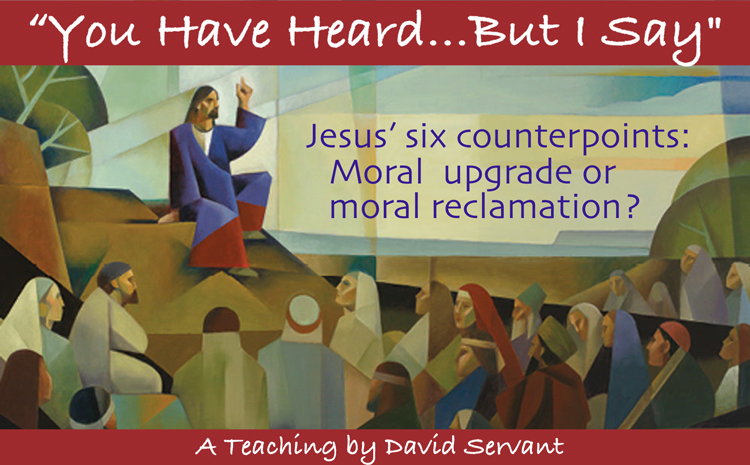
“You Have Heard…But I Say”—Jesus’ Six Counterpoints: Moral Upgrade or Moral Reclamation?

by David Servant

No doubt you’ve heard of Mennonites. Perhaps also of the Amish. Maybe even the Brethren and Hutterites. All fall under the heading of “Anabaptists,” who trace their roots to 16th century Germany and Switzerland. Their predecessors were part of what is known as the Radical Reformation, a response to perceived corruption in both Roman Catholicism and the expanding Magisterial (state-wedded) Protestant movement led by Martin Luther, John Calvin, and others.

E-Teaching Graphic

The early Anabaptists, like the early Christians, were pejoratively named by their persecutors, but in their case because of their distinct doctrine of re-baptizing adults who had already been baptized as babies. The word anabaptist means “one who baptizes again.” Anabaptists noticed that infant baptism, practiced by both Roman Catholics and the Protestants of their day, wasn’t found in the New Testament, and that the apostles seemed to baptize only those who were old enough to understand the gospel, repent of their sins and follow Christ.