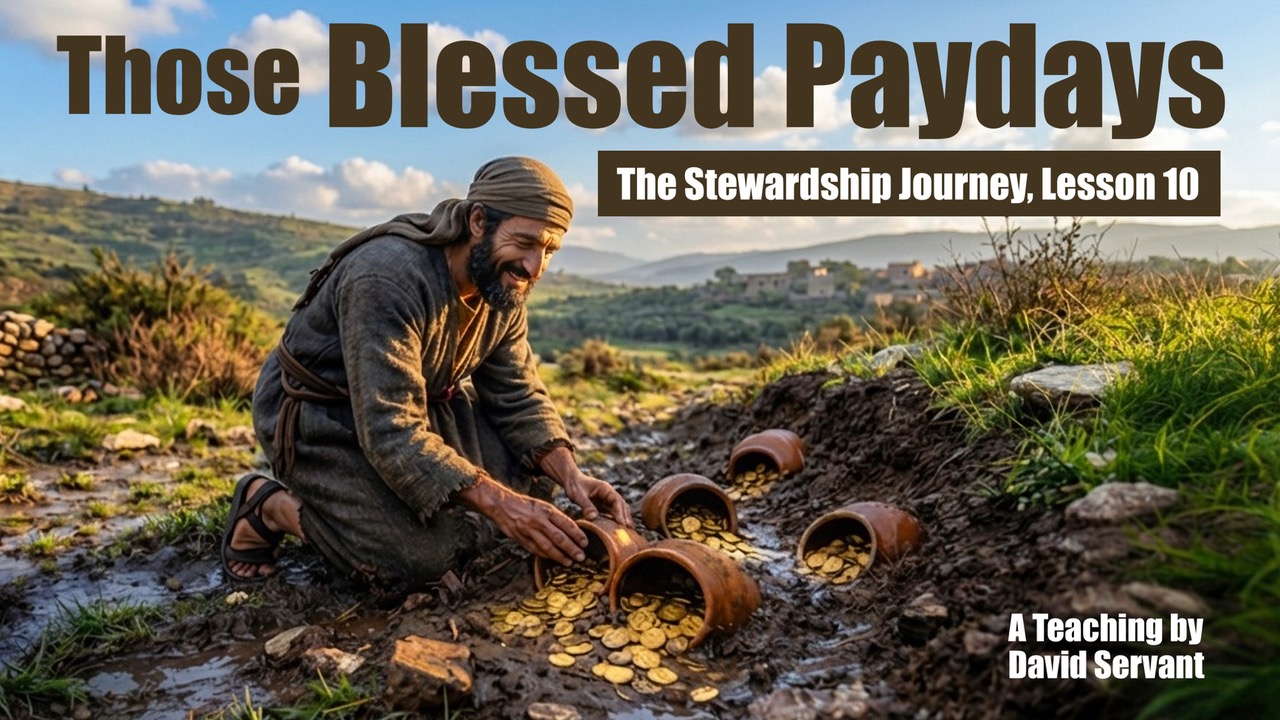
The kingdom of heaven is like a treasure hidden in the field, which a man found and hid again; and from joy over it he goes and sells all that he has and buys that field (Matt. 13:44).
There are many wonderful paydays for those traveling the narrow path to life (Matt. 7:14). The first one occurs at conversion, on the day of repentance and faith in the Lord Jesus Christ. On that day, the new believer’s former sins are all forgiven (2 Pet. 1:9). His spirit is reborn and he becomes a “new creation in Christ” (John 3:1-16; 2 Cor. 5:17). His body becomes a temple of the Holy Spirit (1 Cor. 6:19). God becomes his spiritual Father and he becomes God’s child (1 John 3:1). Eternal life now waits at the end of the narrow path (Rom. 2:6-7). And that is just the short list!
Of all the paydays enjoyed in the Christian life, that first one is perhaps the least appropriate to call a “payday” since the word implies a benefit that is earned. That initial payday is in no sense earned or deserved. Every component is a gift of God’s amazing grace. Yet, as Jesus’ Parable of the Hidden Treasure so paradoxically affirms, enjoying the benefits of God’s grace may cost a person everything.
Following the Lord Jesus Christ may cost one his relationships with friends and family members (Matt. 10:34-37), his reputation (Matt. 5:10-12), his livelihood and possessions (Heb. 10:34), and even his life (John 16:2-3). Yet, as the same parable also affirms, the benefits greatly outweigh the price. Gaining Christ is worth sacrificing everything because the benefits are eternal. As Paul wrote, “I consider that the sufferings of this present time are not worthy to be compared with the glory that is to be revealed to us” (Rom. 8:18).
Other Paydays
We thank God for His wonderful grace. To reduce a believer’s entire relationship with God, however, to nothing more than a relationship of “undeserved favor,” is to ignore practically every page of the Bible. God “is a rewarder of those who seek Him” (Heb. 11:6, emphasis added). Rewards are earned. God has promised to reward everyone “according to their deeds” (Matt. 16:27; Rom. 2:6; 2 Cor. 5:10; Rev. 2:23; 20:12). That is a merit-based promise, not a grace-based promise.
There is coming a major payday for all believers—when they stand before Jesus. That is when we will know exactly how much treasure we have stored up in heaven and when our works will be tested with fire (1 Cor. 3:10-15). Yet there are many paydays between the initial one at conversion and the final one at the judgment seat of Christ. That is the subject of this final lesson.
I have intentionally saved this lesson for last. We’ve now reached the peak of our ascent, and the beautiful view belongs only to those who have persevered in the climb. Now that you’ve arrived, you deserve to know what many others do not: When you care for the “least of these” and/or support God-called ministers, God doesn’t just reward you with treasure in heaven. He also rewards you with treasure on earth.
The reason I didn’t mention this earlier in our stewardship journey is likely the same reason Jesus didn’t say it to the rich young ruler—because God doesn’t want us to give to the poor for personal profit. If we do, we are motivated, not by love, but by selfishness. Remember, Paul wrote, “If I give all my possessions to feed the poor…but do not have love, it profits me nothing” (1 Cor. 13:3, emphasis added). God will not reward giving for the wrong motive. “Giving to get” really isn’t giving at all. Yet Paul’s words strongly imply that God does reward giving motivated by love.
This is the fatal flaw in the teaching of the infamous “prosperity preachers” who litter the spiritual landscape. They grow rich preaching what amounts to sanctified selfishness. They focus solely on the Bible’s promises of blessing for givers while ignoring the greater context.
For example, one of their favorite verses is Luke 6:38, taken from Jesus’ Sermon on the Plain:
Give, and it will be given to you. They will pour into your lap a good measure—pressed down, shaken together, and running over. For by your standard of measure it will be measured to you in return.
All of that is 100% true. Yet Jesus also said in His Sermon on the Mount:
Beware of practicing your righteousness before men to be noticed by them; otherwise you have no reward with your Father who is in heaven. So when you give to the poor, do not sound a trumpet before you, as the hypocrites do in the synagogues and in the streets, so that they may be honored by men. Truly I say to you, they have their reward in full (Matt. 6:1-2).
This brings needed balance to Jesus’ promise in Luke 6:38. Giving to be seen by people earns praise from people but no reward from God. It stands to reason that giving for any wrong motive—including “giving to get”—also results in no reward from God.
Moreover, after quoting Luke 6:38, prosperity preachers often take up collections for their own lavish ministries, as though Luke 6:38 has application to giving to wealthy prosperity preachers. There was, however, no such thing as prosperity preachers when Jesus spoke those words as recorded in Luke 6:38. Everyone who heard His Sermon on the Mount (or any of His other relevant messages), would have understood Him to be talking about giving to the poor.
End of story.
By the way, Jesus did not say to His followers during His Sermon on the Mount, “If you give to the poor” but, “When you give to the poor…”
Because I founded a ministry that focuses on caring for the “least of these” and expanding Jesus’ kingdom, I am blessed to know many generous givers. I can’t count how many times I’ve heard them say, “You can’t outgive God!” Because of their generosity, God blesses them in return. They frequently enjoy those blessed paydays.
And it makes sense. Why wouldn’t God entrust givers with more so they can give more? And why would He wait until heaven to do that?
Conversely, why wouldn’t God withhold financial blessing from those who prove themselves unfaithful with what He has already entrusted to them? The Parables of the Talents and the Ten Minas (Matt. 25:14-30; Luke 19:11-27) both come to mind. The faithful were rewarded; the unfaithful were punished.
Jesus once said, “He who is faithful in a very little thing is faithful also in much; and he who is unrighteous in a very little thing is unrighteous also in much” (Luke 16:10). We must first prove ourselves faithful with little, and as we do, God will entrust us with more.
Proof from Paul
As we saw in Lesson 8, Paul received offerings from churches he founded to benefit the “least of these” in Jerusalem. He devoted two entire chapters in his second letter to the Corinthians to that cause, and the principles he laid out provide an excellent outline for anyone collecting money for the poor.
Paul, of course, wanted the Corinthians to be motivated by love, referring to their giving as “the proof of your love” (2 Cor. 8:24). He did not want their giving to be “affected by covetousness” [pleonexia], a word we have previously learned could also be translated “greed.” That proves once again that neglecting the “least of these” can itself be a form of greed.
I encourage you to read all of 2 Corinthians 8–9, but here is one especially relevant passage from chapter 9:
Now this I say, he who sows sparingly will also reap sparingly, and he who sows bountifully will also reap bountifully. Each one must do just as he has purposed in his heart, not grudgingly or under compulsion, for God loves a cheerful giver. And God is able to make all grace abound to you, so that always having all sufficiency in everything, you may have an abundance for every good deed; as it is written [in Psalm 112:9], “He scattered abroad, He gave to the poor, His righteousness endures forever.” Now He who supplies seed to the sower and bread for food will supply and multiply your seed for sowing and increase the harvest of your righteousness; you will be enriched in everything for all liberality, which through us is producing thanksgiving to God (2 Cor. 9:6-11).
Note that Paul again emphasizes the importance of right motivation. Giving “grudgingly or under compulsion” is not giving motivated by love for God and others. “God loves a cheerful giver”—a giver moved by love and faith.
Notice also that Paul did not say the harvest would come only in heaven. The passage clearly affirms an earthly return meant to enable greater generosity: “God is able to make all grace abound to you, so that always having all sufficiency in everything, you may have an abundance for every good deed.”
Then Paul doubled down: “Now He who supplies seed to the sower and bread for food will supply and multiply your seed for sowing and increase the harvest of your righteousness; you will be enriched in everything for all liberality.” Paul almost sounds like a prosperity preacher! In reality, He sounds like Jesus, who also promised that givers will be blessed (see Luke 6:38).
Supporting Fruitful Ministers
Would you not consider yourself blessed if you had the opportunity to financially support the apostle Paul? Sadly, not everyone who benefited from his ministry seized that opportunity. But the saints in Philippi did, and they sent him an offering more than once. Paul wrote to thank them:
I rejoiced in the Lord greatly, that now at last you have revived your concern for me; indeed, you were concerned before, but you lacked opportunity. Not that I speak from want, for I have learned to be content in whatever circumstances I am. I know how to get along with humble means, and I also know how to live in prosperity; in any and every circumstance I have learned the secret of being filled and going hungry, both of having abundance and suffering need. I can do all things through Him who strengthens me. Nevertheless, you have done well to share with me in my affliction. You yourselves also know, Philippians, that at the first preaching of the gospel, after I left Macedonia, no church shared with me in the matter of giving and receiving but you alone; for even in Thessalonica you sent a gift more than once for my needs. Not that I seek the gift itself, but I seek for the profit which increases to your account. But I have received everything in full and have an abundance; I am amply supplied, having received from Epaphroditus what you have sent, a fragrant aroma, an acceptable sacrifice, well-pleasing to God. And my God will supply all your needs according to His riches in glory in Christ Jesus (Phil. 4:10-18, emphasis added).
We sometimes hear Christians claim, “My God will supply all my needs according to His riches in glory in Christ Jesus.” That promise, however, belongs specifically to those who financially support fruitful ministers like Paul. It is a promise of earthly blessing—the supplying of every need.
In the Old Testament, the giving of tithes (which, as we have seen, were meant for priests and the poor) was certainly connected to earthly blessing:
“Will a man rob God? Yet you are robbing Me! But you say, ‘How have we robbed You?’ In tithes and offerings. You are cursed with a curse, for you are robbing Me, the whole nation of you! Bring the whole tithe into the storehouse, so that there may be food in My house, and test Me now in this,” says the Lord of hosts, “if I will not open for you the windows of heaven and pour out for you a blessing until it overflows. Then I will rebuke the devourer for you, so that it will not destroy the fruits of the ground; nor will your vine in the field cast its grapes,” says the Lord of hosts. “All the nations will call you blessed, for you shall be a delightful land,” says the Lord of hosts (Mal. 3:8-12).
By withholding their tithes and offerings, the people of Israel were inviting God’s curse on their harvest. Their repentance, however, would bring an end to the curse and usher in an overflowing blessing.
Notice also that God declared that by withholding what should have been shared with the priests and the poor, they were robbing Him. This is the same message Jesus conveyed in His teaching about the future judgment of the sheep and the goats. To neglect the poor in God’s family is to neglect God Himself.
This same theme of God’s identification with the poor appears in Proverbs:
One who is gracious to a poor man lends to the Lord,
And He will repay him for his good deed (Prov. 19:17, emphasis added)
And once again, we see a promised repayment with no mention of heaven.
Here are two more promises from Proverbs of earthly blessing for those who care for the poor:
He who is generous will be blessed,
For he gives some of his food to the poor (Prov. 22:9).
He who gives to the poor will never want,
But he who shuts his eyes will have many curses (Prov. 28:27).
Helping the Poor Lift Themselves
The absolute best way to help the poor is to help them lift themselves out of poverty—with dignity through their own efforts. When equipped with tools, knowledge, skills, or employment opportunities, the poor generally get right to work.
Heaven’s Family has done this for thousands of poor subsistence farmers across East and Southern Africa. When we first meet them, they often cannot grow enough food to feed their families. Their meager harvests run out, and they endure what everyone calls the “hunger season.”
Through agricultural training in “Farming God’s Way,” however, their very next harvest is typically two to three times larger. As they continue practicing these methods, harvests keep increasing. They become self-sufficient and are enabled to care for local widows and orphans. The agricultural training takes place in the context of house churches we call “God’s Love Groups,” where members also learn to follow Jesus. It is holistic ministry at its finest—ministering to spirits, souls, and bodies.
You are probably thinking, “I’ll bet David wrote these lessons to persuade me to invest in Heaven’s Family.” You are partially right. The full truth is that I wrote them so the millions among the “least of these” would no longer be ignored and neglected, but would be loved by the millions who claim to love Jesus. In so doing, believers not only demonstrate their love for Christ, but they also store up treasure in heaven and experience God’s abundant earthly provision that belongs to the generous.
Now you know what God expects of us concerning the “least of these.” Will you obey? You also have an obligation to steward the relationships God has entrusted to you by sharing what you know with others so they, too, can align their lives with God’s will. Will you?
I’ll close with the lyrics to a song I wrote years ago that seemed to be from His heart. It is titled, I Cared, I Died. You can listen to the actual song by visiting the home page of HeavensFamily.org and clicking on the song title.
1.) I see a poor old man
Who lives in Pakistan
Sitting by his fire
As the full moon rises higher.
He stares up at the stars
Wondering what they are
And who put them there.
Is there a God who cares about him?
I care, I died.
I bore the guilt for all his sins.
But who will go or send someone?
Who cares enough to tell him what I did?
2.) A widow in Sudan
Driven from her land
I see her face is worn
I see her clothes are tattered and torn.
She knows she is My child
And she prays to Me out loud
Asking for some bread
Before her crying daughter is dead.
I care, I died.
I want to answer her simple prayer.
But I’ve entrusted much to some
So they will use what I’ve given them to share.
3.) I see a Russian boy
He’s never owned a toy
Living on the streets
Scavenging for what he eats, every day.
At night he sleeps alone
Longing for a home
Where some love is found
Where he can feel some arms around him.
I care, I died.
I want this child in a family.
Who will share their home with him?
Who will show him the love they have for Me?
4.) I see the millions more
Safe behind church doors
Wealthy and secure
But to Me they are wretched and poor.
They pray that they’ll be blessed
That I’ll grant them more success;
Why do they call Me Lord?
My commandments are ignored.
I care, I died
I’m calling you to wake from sleep.
When will you understand?
Only those who deny themselves are My sheep.