Having considered in the previous lesson several sections of Jesus’ Olivet Discourse (Matt. 24-25; Mark 13; Luke 21), namely, the Parables of the Unfaithful Servant, Ten Virgins, and Talents, we are better equipped to properly interpret the concluding section—Jesus’ foretelling of the future judgment of the sheep and goats.
Recall that Jesus was speaking in His Olivet Discourse, not to the multitudes, but to four of His closest disciples—Peter, James, John and Andrew (Mark 13:3). Therefore, what Jesus said had application to them. That is undeniable.
The overriding general theme was that they should remain ready for the return of their Master—unlike the unfaithful servant, five foolish virgins, and one-talent slave—lest they suffer similar fates as they did. More specifically, they should remain ready by persevering in obedience so that, when their Master returned, they would be found doing His will. If they were not found faithfully serving Him, they would not only be denied access to the wedding feast (Matt. 25:10-12), but would be assigned “a place with the hypocrites” in “the outer darkness” where there “will be weeping and gnashing of teeth” (Matt. 24:51; 25:30).
That is how Peter, James, John and Andrew would have interpreted Jesus’ words. They were Jesus’ audience. The word you is found 62 times in Jesus’ Olivet Discourse as it was recorded by Matthew in chapters 24 and 25 of his Gospel.
Recall also that the section of Jesus’ Olivet Discourse that preceded those three parables contains numerous admonitions for those four disciples to not be misled as His return drew closer, and to remain ready and prepared (see Matt. 24:1-44). That pre-parable section ends with His words, “For this reason you also must be ready; for the Son of Man is coming at an hour when you do not think He will” (Matt. 24:44). That sentence sets the stage for the three parables that follow, all of which, again, tell the stories of people who were not ready at the return of their master or a bridegroom, and who suffered irrevocably because of their unreadiness. The message is clear.
Taken altogether, Jesus’ Olivet Discourse was a solemn sermon. And it hasn’t grown less solemn over the past 2,000 years as His return has grown nearer. Because Jesus admitted that He Himself did not know the “day and hour” (Matt. 24:36) of His return, He was love-bound to warn His contemporary disciples, because they stood a chance of being alive when it occurred. Of course, every successive generation of Christians should take His words just as seriously as Peter, James, John and Andrew did. In fact, in the light of the fact that we are living 2,000 years closer to Jesus’ return than they were, we should, if it is possible, take Jesus’ words even more seriously.
The Specifics of Being Ready
If we survey the Olivet Discourse from the beginning through the Parable of the Talents in search of specific moral misbehaviors that identify one as being unprepared for Jesus’ return, there are few. I can only find references to “beating fellow servants” and “eating and drinking with drunkards” (Matt. 24:49), both found in Jesus’ description of the unfaithful servant in His first Olivet parable. It is therefore not surprising that He would, by the end of His discourse, include something more specific regarding essential moral behaviors that could affect the preparedness of His disciples at His return. And Jesus did just that, in His foretelling of the future judgment of the sheep and goats. There Jesus contrasted two kinds of people—those who will be ready to stand before Him and those who will not. The “readiness” theme doesn’t change. And the moral behavior that determines readiness is crystal clear.
Surprisingly, Jesus didn’t list any of the Ten Commandments. We might have thought He would have repeated the five He enumerated in His answer to the rich young ruler (see chapter 5). But He didn’t. Rather, it seems He focused on His “new commandment” (John 13:34), the commandment that Christians love one another. More specifically, He focused on the necessity of investing time and treasure to care for other believers who are facing lack of food, drink, shelter, clothing or health, or suffering imprisonment. He referred to those suffering believers as “these brothers of Mine, even the least of them” (Matt. 25:39). He equated serving them to serving Him and neglecting them to neglecting Him. Let’s read that entire section of Jesus’ Olivet Discourse:
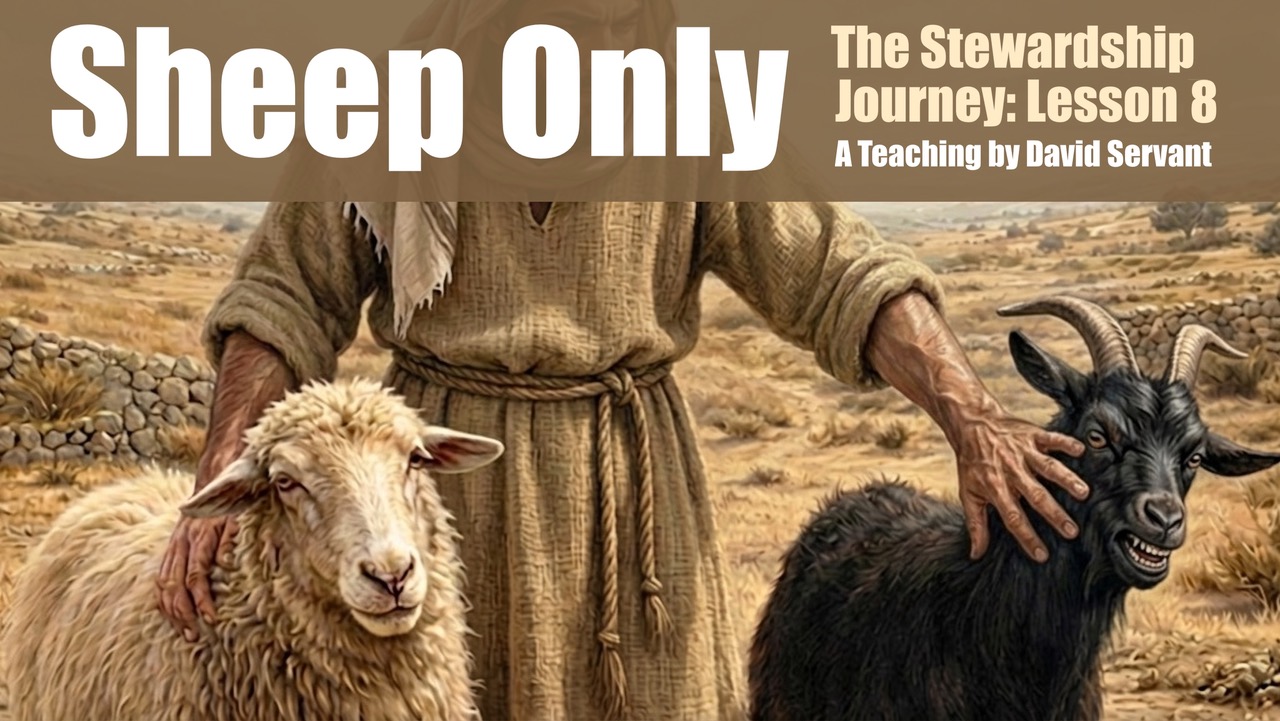
But when the Son of Man comes in His glory, and all the angels with Him, then He will sit on His glorious throne. All the nations will be gathered before Him; and He will separate them from one another, as the shepherd separates the sheep from the goats; and He will put the sheep on His right, and the goats on the left.
Then the King will say to those on His right, “Come, you who are blessed of My Father, inherit the kingdom prepared for you from the foundation of the world. For I was hungry, and you gave Me something to eat; I was thirsty, and you gave Me something to drink; I was a stranger, and you invited Me in; naked, and you clothed Me; I was sick, and you visited Me; I was in prison, and you came to Me.” Then the righteous will answer Him, “Lord, when did we see You hungry, and feed You, or thirsty, and give You something to drink? And when did we see You a stranger, and invite You in, or naked, and clothe You? When did we see You sick, or in prison, and come to You?” The King will answer and say to them, “Truly I say to you, to the extent that you did it to one of these brothers of Mine, even the least of them, you did it to Me.”
Then He will also say to those on His left, “Depart from Me, accursed ones, into the eternal fire which has been prepared for the devil and his angels; for I was hungry, and you gave Me nothing to eat; I was thirsty, and you gave Me nothing to drink; I was a stranger, and you did not invite Me in; naked, and you did not clothe Me; sick, and in prison, and you did not visit Me.” Then they themselves also will answer, “Lord, when did we see You hungry, or thirsty, or a stranger, or naked, or sick, or in prison, and did not take care of You?” Then He will answer them, “Truly I say to you, to the extent that you did not do it to one of the least of these, you did not do it to Me.” These will go away into eternal punishment, but the righteous into eternal life (Matt. 25:31-46).
Recall again that Jesus was speaking to Peter, James, John and Andrew, instructing them to be ready for His return, at which time everyone, including them, will be judged. How would they have interpreted His words we just read? Jesus’ message couldn’t be clearer: “Peter, James, John and Andrew, in order to be ready to stand before Me, you must relieve the sufferings of those who love Me.” Bible teachers and theologians are apt to clarify Jesus’ words for us lest we misunderstand them, quickly explaining that our works can’t save us, but that genuine believers, represented by the sheep, demonstrate their faith by their works of love. I would agree, but Jesus didn’t feel any need to add that clarification when He spoke to Peter, James, John and Andrew. Perhaps we should have the humility to question why we need to always say what He didn’t.
The Four Follow Through
Did those four disciples take Jesus’ words to heart? I think it is safe to say that they passed them on to the thousands of new believers in the early church in Jerusalem:
They were continually devoting themselves to the apostles’ teaching… And all those who had believed were together and had all things in common; and they began selling their property and possessions and were sharing them with all, as anyone might have need (Acts 2:42-45, emphasis added).
And the congregation of those who believed were of one heart and soul; and not one of them claimed that anything belonging to him was his own, but all things were common property to them. And with great power the apostles were giving testimony to the resurrection of the Lord Jesus, and abundant grace was upon them all. For there was not a needy person among them, for all who were owners of land or houses would sell them and bring the proceeds of the sales and lay them at the apostles’ feet, and they would be distributed to each as any had need. Now Joseph, a Levite of Cyprian birth, who was also called Barnabas by the apostles (which translated means Son of Encouragement), and who owned a tract of land, sold it and brought the money and laid it at the apostles’ feet (Acts 4:32-37, emphasis added).
Keep in mind that the kind of needs that were being met would have been basic necessities of food, drink, covering and shelter. The early believers were caring for the “least of these.”
Jesus’ words so impacted the original apostles that their direct involvement in caring for the poorest among them—who kept growing in number as the church grew—hindered their preaching of the gospel, teaching the Word, and praying—an unbalance they had to correct:
Now at this time while the disciples were increasing in number, a complaint arose on the part of the Hellenistic Jews against the native Hebrews, because their widows were being overlooked in the daily serving of food. So the twelve summoned the congregation of the disciples and said, “It is not desirable for us to neglect the word of God in order to serve tables. Therefore, brethren, select from among you seven men of good reputation, full of the Spirit and of wisdom, whom we may put in charge of this task. But we will devote ourselves to prayer and to the ministry of the word.” The statement found approval with the whole congregation; and they chose Stephen, a man full of faith and of the Holy Spirit, and Philip, Prochorus, Nicanor, Timon, Parmenas and Nicolas, a proselyte from Antioch. And these they brought before the apostles; and after praying, they laid their hands on them (Acts 6:1-6).
Needless to say, the Twelve considered caring for the poorest among them, the “least of these,” to be an essential component of their faith.
About 16 years later, when Paul journeyed with Barnabas to Jerusalem to submit his gospel to the scrutiny of Peter, James[1] and John, they found no fault with what he was proclaiming to the Gentiles. They did, however, want to make sure his gospel was coupled with a call to action to believing Gentiles to care for the “least of these:”
But on the contrary, seeing that I had been entrusted with the gospel to the uncircumcised, just as Peter had been to the circumcised (for He who effectually worked for Peter in his apostleship to the circumcised effectually worked for me also to the Gentiles), and recognizing the grace that had been given to me, James and Cephas and John, who were reputed to be pillars, gave to me and Barnabas the right hand of fellowship, so that we might go to the Gentiles and they to the circumcised. They only asked us to remember the poor—the very thing I also was eager to do (Gal. 2:7-10, emphasis added).
Paul did remember the poor. He later received offerings from predominately Gentile churches in order to serve suffering Jewish believers in Jerusalem. He wrote to the believers in Rome:
Now, I am going to Jerusalem serving the saints. For Macedonia and Achaia have been pleased to make a contribution for the poor among the saints in Jerusalem. Yes, they were pleased to do so, and they are indebted to them (Rom. 15:25-27).
Think about it: The greatest Christian apostle viewed caring for poor believers to be a vital component of his ministry. Five to ten years after Peter, James and John asked him to “remember the poor,” Paul wrote two entire chapters in his second letter to the Corinthians to persuade them to participate in a collection for the poor (2 Cor. 8-9), selling it as “obedience to your confession of the gospel of Christ” (2 Cor. 9:13). That is, if they claimed to believe the gospel, they should prove it by caring for the “least of these.”
Paul had already instructed the Corinthian believers in an earlier letter: “On the first day of every week each one of you is to put aside and save, as he may prosper, so that no collections be made when I come” (1 Cor. 16:2). Although that verse is often used to encourage people to give every week to their local church, the context indisputably reveals that Paul was talking about putting aside money every week for the “least of these.” That is indisputable. When was the last time you heard a sermon about that?
Back to the Sheep and Goats
Having now read Jesus’ solemn warnings in His Olivet Discourse that culminate in His foretelling of the future judgment of the sheep and goats, and having followed the early church’s decades-long chain of obedience, and knowing that Matthew 25:31-46 is still in every Bible, we must ask why such an important component of the faith is being essentially ignored by the majority of the modern Christians.
One reason is that Jesus’ words have been made irrelevant by false teaching.
As I have previously written, some claim that there can be no behavioral requirement for ultimate salvation since we are “saved by grace” (Eph. 2:8) under the new covenant. And because Jesus repeatedly taught that there are behavioral requirements for ultimate salvation, salvation must have been “by works” under the old covenant, which is when He ministered. So, it is alleged that the relevancy of Jesus’ words regarding salvation only lasted until the new covenant was inaugurated by His death and resurrection. Thus, the “logic” continues, Jesus’ foretelling of the judgment of the sheep and goats has no relevancy for Christians under the new covenant, but only for those who lived under the old covenant.
If that were true, it would make Jesus’ foretelling of the future judgment of the sheep and goats, as well as His Parables of the Unfaithful Servant, Ten Virgins and Talents, all irrelevant in less than a week, since His Olivet Discourse occurred no more than four days before His crucifixion. Within just seven days, everything Jesus said in those sections of His Olivet Discourse could be safely ignored and forgotten by Peter, James, John and Andrew! What then was the point of Jesus telling them about the future judgment of the sheep and goats if they were essentially guaranteed to never experience it?
Moreover, the judgment of the sheep and goats is a future judgment that will occur when Jesus returns, and it will be a judgment of works that determines salvation or damnation. How could it possibly only be relevant to people who lived during the old covenant when the entire judgment revolves around how people treated other Christians? Only Christians live under the new covenant, and only they can be considered to be Jesus’ “brothers” and one with Him (1 Cor. 6:17), so that to serve them is to serve Him and to neglect them is to neglect Him. It would be impossible to judge people who lived before the new covenant based on how they treated people who lived during the new covenant.
Of course, the foundational premise that people under the old covenant were saved by works is entirely unbiblical. Salvation has always been by grace through faith, before, during and after the old covenant. Faith has always been validated by works. And everyone will be judged by their works.
Moreover, it was not just Jesus who taught that there are behavioral requirements for ultimate salvation. It was also Paul, Peter, James, John and Jude. We are not saved by any alleged “unconditional grace,” but rather, by a conditional grace. Those who teach that God’s grace is unconditional “turn the grace of our God into licentiousness,” and by so doing, “deny our only Master and Lord, Jesus Christ” (Jude 4).
Another Bizarre Theory
Because the first part of the Olivet Discourse mentions Jerusalem and Judea and foretells of a time of great tribulation in Israel that will precede Jesus’ return, some claim that the sheep represent those nations that will prove themselves merciful towards modern, political Israel during the tribulation that precedes Jesus’ return, and the goats represent those nations that will be hostile towards the modern political nation of Israel. Those nations that were merciful will be permitted to remain when Jesus sets up His earthly kingdom, and those that were hostile will not be permitted to remain. (I even recently heard a sermon in which the teacher claimed that anyone who doesn’t support modern, political Israel’s every military action against its regional enemies is antisemitic, and such persons will find themselves among the goats at the judgment that Jesus foretold in Matthew 25:31-46. No joke!)
This theory is so unscriptural that I hardly know where to start.
First, although Jesus will gather “all the nations” and “separate them from one another, as the shepherd separates the sheep from the goats” (Matt. 25:32), we are not to think he will separate “sheep geo-political nations” from “goat geo-political nations.” The word translated “nations” in Matthew 25:32 is the Greek ethnos. It refers to a group of people united by kinship, culture, language, or customs—essentially a race, tribe, people, or nation. Jesus’ point is that people from all the world’s groups will be gathered to stand judgment and be divided into two groups.
Second, the Bible foretells that all the nations of the world will be aligned against unbelieving Israel just prior to the return of Jesus. There will be no “sheep nations”:
Behold, a day is coming for the Lord when the spoil taken from you will be divided among you. For I will gather all the nations against Jerusalem to battle, and the city will be captured, the houses plundered, the women ravished and half of the city exiled, but the rest of the people will not be cut off from the city. Then the Lord will go forth and fight against those nations, as when He fights on a day of battle. In that day His feet will stand on the Mount of Olives, which is in front of Jerusalem on the east; and the Mount of Olives will be split in its middle from east to west by a very large valley, so that half of the mountain will move toward the north and the other half toward the south. You will flee by the valley of My mountains, for the valley of the mountains will reach to Azel; yes, you will flee just as you fled before the earthquake in the days of Uzziah king of Judah. Then the Lord, my God, will come, and all the holy ones with Him! (Zech. 14:1-5, emphasis added).
Third, the judgment of the sheep and goats concludes with the sheep “inheriting eternal life” and the goats being cast into the “eternal fire” (Matt. 25:41, 46). So, if the nation of Japan shows mercy towards political Israel during the tribulation that precedes Jesus’ return, will all Japanese citizens inherit eternal life? And if the nation of Russia is hostile towards political Israel during that same tribulation, will all Russians be cast into the eternal fire? Will eternal salvation or damnation be determined by peoples’ citizenry?
Fourth, when Jesus spoke of “His brothers” who are among the “least,” He was not speaking of Jewish “brothers” who share with Him the DNA of ancient Jacob. He was speaking of His spiritual brothers—those who do the will of His Father, as He said in Matthew 12:46-50. How could it possibly be thought that by being merciful to Christ-rejecting Jews in Israel that one is being merciful to Christ? Only believers in Christ are members of His body and indwelt by His Holy Spirit, one spirit with Him (Eph. 5:30; 1 Cor. 6:17, 19).
Fifth, and perhaps most importantly, is it even remotely possible that, as Peter, James, John and Andrew listened to Jesus talk about the future judgment of the sheep and goats, they thought He was warning them that there would be “sheep nations” and “goat nations” whose citizens’ eternal destinies would be determined by how their nations treated political Israel just prior to Jesus’ return? The idea is utterly absurd.
How Then Shall We Live?
One other reason Jesus’ words regarding the salvific necessity of caring for the “least of these” are ignored is because so many of us live in Disney World. That is, we live on an island of wealth in a sea of poverty. We don’t have neighbors who are drinking water they collect from mud puddles. We don’t know anyone whose children are crying themselves to sleep with hunger. We can’t imagine hoping for an opportunity to work all day for $5. Lazarus will never be laid at our gate. So, “Out of sight, out of mind.” And are we not responsible to only care for those in close proximity, as prescribed in the Lord’s commandment to love our neighbors as ourselves?
As members of God’s family, we are not only responsible to love our neighbors, but to “love one another” as prescribed in Jesus’ “new commandment” (John 13:34), and without any geographical limits. That is why Paul collected offerings from Christians in Corinth, ancient Greece, for the benefit of poor believers in Jerusalem, Israel, 800 miles away as the crow flies.
“But the standard of living is so much higher in developed nations like the one in which I live, and I have a hard time making ends meet!” is a common excuse for a lack of compassion for the “least of these.” The “higher standard of living” justification, however, is a weak one. If any of us lost our jobs for an extended period of time, we would find ways to cut expenses and live on less. And if anyone in any poor nation suddenly enjoyed a windfall of prosperity, they could easily find ways to increase their expenses.
Just for some perspective, if you have an annual income of $50,000 (slightly below the U.S. median individual income in 2026), that puts you in the top 5-10% worldwide. The bottom 50% of the world’s adults earn about $5,000 per year on average. If you have a net worth of $100,000, you are wealthier than 82% of the world’s adults. The bottom 40% of the world’s adults have almost no measurable net worth beyond basic possessions[2].
To read Jesus’ foretelling of the future judgment of the sheep and goats and react with any excuse for ignoring it is a telling revelation of the condition of one’s heart. A person who truly loves Jesus would react with joy, thinking to himself, “Oh praise God! I can serve Jesus and show my love for Him by caring for the “least of these” among His family! I must find some of those people as soon as possible!”
When Paul wrote to the Corinthian believers about his collection for the poor Christians in Jerusalem, he first told them about the attitude of the believers in Macedonia:
Now, brethren, we wish to make known to you the grace of God which has been given in the churches of Macedonia, that in a great ordeal of affliction their abundance of joy and their deep poverty overflowed in the wealth of their liberality. For I testify that according to their ability, and beyond their ability, they gave of their own accord, begging us with much urging for the favor of participation in the support of the saints (2 Cor. 8:1-4).
Paul didn’t beg the Macedonian believers to contribute to his collection; they begged him to participate in his collection! It was an opportunity to show their love for Jesus by loving the “least of these.” It seems Paul may have even been hesitant to ask them to participate in his collection because of their own deep poverty, but they persuaded him, repeatedly begging “for the favor of participation in the support of the saints.” He acquiesced. And God supernaturally enabled them to give “beyond their ability.” Paul characterized it all as a manifestation of God’s grace. Grace had transformed selfish people into sacrificial lovers of people whom they had never met, but who were members of the same spiritual family. That should be the testimony of everyone who has been truly born again.
A Love-Link for You
Let me close this chapter with some good news just for you, dear born-again reader: I am connected with the “least of these” all over the world. Decades ago, I founded an organization called Heaven’s Family that has served impoverished believers in 80 nations. Our core scripture is Matthew 25:31-46, Jesus’ foretelling of the judgment of the sheep and goats. As I’m writing these words, I am riding in an old car in Malawi, the 173rd nation among 191 nations on the Human Development Index. This is a nation of needs. I’ve spent the last four days visiting Heaven’s Family’s projects in remote villages.
My traveling companion and I have been greeted in every village with joyful singing and traditional dancing. We’ve listened to the happy testimonies of men and women whose lives have been changed because of the agricultural methods they’ve learned from our partners. Their harvests of maize, which previously were not sufficient to feed their families for a year, have doubled, tripled, quadrupled, and more. For the first time in their lives, they have sufficient food to eat plus crops to sell, which means money to pay school fees for their children and for medicine when a family member becomes ill.
At every village, the people have either thanked us for the water well that we’ve already drilled or begged us for one that will serve their village. Yesterday, at one of those villages, a mother of eleven children told us that she’s lost seven of them to water-borne diseases, like cholera. So far, Heaven’s Family has drilled 70 wells in Malawi alone. The only thing that hinders the pace of our drilling is lack of funding.
The best news we’ve heard over the past four days is that, because of our strategic partnerships with some of Jesus’ choice servants in Malawi whom we have been privileged to train, 460 house churches have been planted in just a few years. 150 of those churches consist entirely of Muslim-background believers who now worship Jesus—their Lord who has blessed them with abundant food and safe water.
I founded Heaven’s Family in 2002 to serve two groups of people—the “least of these” who live in a world of poverty, and people like you and me who live in Disney World. Heaven’s Family is a bridge between those two very different worlds, benefitting people in both for time and eternity. And you can be a part of it. You won’t have to beg for “the favor of participation in the support of the saints.” We’re working every day around the world to make it easy for you to demonstrate your love for Jesus by caring for the “least of these.” You can start today by navigating to HeavensFamily.org/Compassion-Club. Why wait? Only the sheep are ready to stand before Jesus.
The All-Important Questions: If Jesus returned today, would I be ready because He would find me doing His will? Does my Christian life resemble that of the early Christians, so that caring for the “least of these” is an important component? Have I been making excuses in order to ignore my God-given responsibility to care for the “least of these”? Is my love for Jesus being expressed by my sacrifices for them?
[1] This was a different man than the James who heard Jesus’ Olivet Discourse.
[2] For more precise information regarding how you compare to the rest of the world, visit www.givingwhatwecan.org/how-rich-am-i