If Jesus wasn’t already your Master as you read Lesson 1, I trust that He has since become your Master. If He’s still not your Master, there is no sense making any attempt to continue on The Stewardship Journey. The first step is to believe in Jesus, which is synonymous with becoming His follower.
Many professing Christians will tell you that they have “accepted Jesus,” but if you’ve ever read the four Gospels, you know that Jesus never encouraged anyone to accept Him. He wasn’t looking for “accepters.” He was looking for followers. He said, “If anyone wishes to come after Me, he must deny himself, and take up his cross daily and follow Me” (Luke 9:23). Clearly, following Him requires self-denial.
Some attempt to persuade us that there are actually two categories of Christians—the believers and the disciples. Believers, they claim, are born again, secure in God’s saving grace, and guaranteed eternal salvation, but they are not necessarily committed to obey Jesus. Disciples, they claim, are also believers, but they are committed to follow and obey Jesus, and they will thus receive greater reward in heaven.
The New Testament, however, makes no distinction between believers and disciples. Rather, it clearly portrays all true believers as being disciples, that is, committed followers. There are about 260 verses in the Gospels and Acts that contain the word disciple or disciples. There are only 3 verses in those same New Testament books that contain the word believer or believers and only 2 verses that contain the word Christian or Christians. What does that tell us?
Once when Jesus was preaching to a crowd of Jews, John tells us that “many came to believe in Him” (John 8:30, emphasis added). Jesus immediately called them to question if their faith was genuine:
So Jesus was saying to those Jews who had believed Him, “If you continue in My word, then you are truly disciples of Mine; and you will know the truth, and the truth will make you free” (John 8:31-32, emphasis added).
Did you notice that Jesus spoke to professing believers as if they were professing disciples? That is because the two were synonymous in His mind. Anyone who truly believes in Jesus will “continue in His Word” and thus progressively be set free from the slavery of sin as they learn His Word and obey it.
Jesus’ Demands of Discipleship
Luke records that, as Jesus once addressed “large crowds” that were “going along with Him” (Luke 14:25), He enumerated three requirements for those who wanted to be His disciples. Those who were unwilling to meet His three conditions disqualified themselves.
First, they must love Him supremely—more than father, mother, wife, children, brothers, sisters, and even their own life (Luke 14:26). Jesus used the strong term “hate” to drive home His point. Allegiance to Him must eclipse every other attachment, including even the closest family ties and self-preservation.
Second, they must deny themselves, take up their cross daily, and follow Him (Luke 14:27; cf. 9:23). That figuratively describes a willingness to embrace suffering, shame, and self-renunciation for His sake—bearing the cost of discipleship without reservation.
Third, they must renounce ownership of all their possessions (Luke 14:33). No one, Jesus said, can be His disciple who does not “give up” (or “renounce”) everything he has, placing all material goods under His lordship.
Jesus’ demands were not just suggestions. They were the non-negotiable marks of genuine commitment. Clearly, He was not content being a “mega-church pastor,” nor was He satisfied with large crowds of spectators. Rather, He wanted committed followers. He deliberately thinned the crowds. True discipleship requires total allegiance—heart, life, and possessions—to Jesus alone.
Regarding Jesus’ third requirement for discipleship (giving up all of one’s possessions), I’ve softened it as much as the immediate and wider biblical context would seem to allow. Rather than paraphrasing Jesus’ words, “No one can be My disciple who does not liquidate all his assets, distribute the proceeds to the poor, and thereafter live in perpetual poverty while serving others with any surplus,” I’ve rendered it, “No one can be My disciple who does not renounce everything He has, placing all material goods under His lordship.”
It is quite easy, however, to fool ourselves into thinking that we’ve placed all material goods under Jesus’ lordship “in our hearts” while making no material adjustments in our lives. Mental relinquishment is obviously not the same as actual relinquishment. The fact is, greed may not only be manifested by how we gain wealth, but also by what we do with it once it is gained. In this lesson, we are going to take a look at a man who was guilty of that second form of greed. His story was recorded only in Luke’s Gospel.
The Victim
Luke tells us that, as Jesus was once preaching to a crowd of thousands (see Luke 12:1), a man said to Him, “Teacher, tell my brother to divide the family inheritance with me” (Luke 12:13). I think it is safe to assume the man’s brother was also in the crowd. The defrauded victim hoped that Jesus would take his side, publicly correct his brother, and he would then gain his rightful share of the family inheritance.
Jesus was not, however, willing to render a judgment. He said, “Man, who appointed Me a judge or arbitrator over you?” (Luke 12:14). This was a case for the courts, or at least for someone whom both brothers trusted and who had the time and inclination to carefully examine all the relevant facts. Perhaps the man was not the victim he portrayed himself to be. We don’t know.
Jesus did, however, seize the opportunity to address a more important issue that could affect not just the two brothers’ net worth, but their eternal destiny. He said to them, “Beware, and be on your guard against every form of greed; for not even when one has an abundance does his life consist of his possessions” (Luke 12:15).
The danger that was surfacing in their dispute was the danger of greed. Both men were potentially focused too much on possessions. The brother who felt defrauded was so obsessed with material wealth that he not only made it a public issue in front of a large crowd, but he also attempted to involve the Messiah right during His public ministry. That was highly inappropriate, and it revealed his fixation. Moreoever, if his brother was indeed defrauding him of his rightful inheritance, then his selfish brother was revealing that money, rather than God, was his master. Because greed is a damning sin (as we saw in our first lesson), both men were potentially in grave danger.
From Jesus’ words to the crowd that day, we learn several things. The first is that there are different forms of greed. Jesus said, “Beware, and be on your guard against every form of greed.” Obviously, the two men’s dispute revealed at least one form, and it would seem to be in the category of greed associated with how one gains wealth rather than how one uses it. In this case, if either brother was attempting to defraud the other, it was an attempt to gain wealth through theft. Again, theft reveals that money, not God, is one’s master. It’s a form of greed.
Jesus indicated that the root of all greed is a false valuation of material things: “Beware, and be on your guard against every form of greed; for not even when one has an abundance does his life consist of his possessions.”
Material possessions, of course, are a necessary part of everyone’s life. At bare minimum, we all need food and clothing. But there is something even more important than possessions. What is it? It is a relationship with God that is marked by obedience to Him. When that is usurped by a focus on material possessions, greed is rearing its ugly head. Another god is competing for mastership. Time to beware!
Jesus elaborated by telling the crowd a parable about a wealthy man:
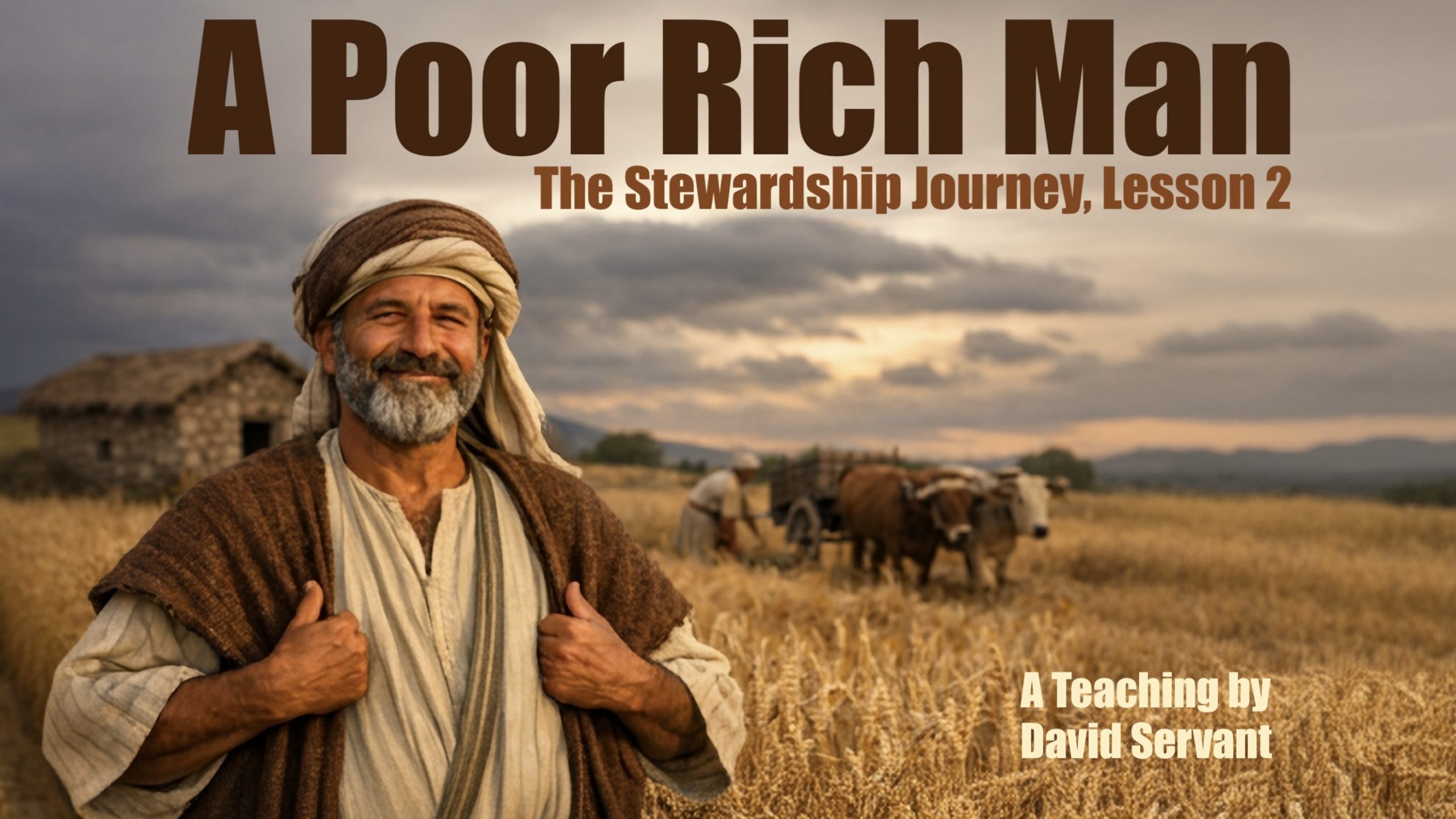
The land of a rich man was very productive. And he began reasoning to himself, saying, “What shall I do, since I have no place to store my crops?” Then he said, “This is what I will do: I will tear down my barns and build larger ones, and there I will store all my grain and my goods. And I will say to my soul, ‘Soul, you have many goods laid up for many years to come; take your ease, eat, drink and be merry.’ But God said to him, “You fool! This very night your soul is required of you; and now who will own what you have prepared?” So is the man who stores up treasure for himself, and is not rich toward God” (Luke 12:16-21).
Note that there is no indication that the wealthy man in Jesus’ parable was guilty of greed in regard to how he obtained his wealth. It appears that he gained it legitimately through farming. In fact, his success had a lot to do with God’s blessing, as crops need rain and sun.
That being so, the form of greed of which he became guilty revolved around what he did with his God-granted wealth. Jesus said that he “stored up treasure for himself” (Luke 12:21). We know exactly what Jesus meant by that expression from what He said at other times about storing treasures in heaven by caring for the poor (see Matt. 6:20; 19:21; Luke 12:33).
We can all store treasure on earth or in heaven. That is where the rich man failed. He stored all his treasure on earth. Money, not God, was his god. He was greedy, and thus an idolater. And his greed stemmed from his overvaluation of material possessions. They were more important to him than a relationship with God marked by obedience. He was, as Jesus said, “not rich toward God” because he didn’t obey God in regard to the use of his wealth. He was a poor rich man.
Moreover, he was also a foolish poor rich man, as God Himself said, because his entire reason for storing up treasure for himself was so that he could enjoy his future years living in ease. His life, however, ended within hours. It was a grave miscalculation on his part.
Jesus left us no reason to think that the rich man, being so foolish and “not rich toward God,” found himself in heaven after his unexpected death. In light of all Jesus taught, it seems more reasonable to think that the rich man found himself in hell. He had expected many future years of an easy earthly life made possible by his earthly store of treasure, but within hours he was living in agony and regret, having forever forfeited any access to his treasure. He was indeed a fool. And we are no different than him if we only store our treasure on earth and neglect to store any in heaven. We show ourselves to be servants, not of God, but of money.
Application to Rich and Poor Alike
But Jesus’ words in Luke 12 not only have application to those who are wealthy, but to everyone. Because directly after His parable of the rich fool, Jesus turned to His disciples and said:
For this reason I say to you, do not worry about your life, as to what you will eat; nor for your body, as to what you will put on. For life is more than food, and the body more than clothing. Consider the ravens, for they neither sow nor reap; they have no storeroom nor barn, and yet God feeds them; how much more valuable you are than the birds! And which of you by worrying can add a single hour to his life’s span? If then you cannot do even a very little thing, why do you worry about other matters? Consider the lilies, how they grow: they neither toil nor spin; but I tell you, not even Solomon in all his glory clothed himself like one of these. But if God so clothes the grass in the field, which is alive today and tomorrow is thrown into the furnace, how much more will He clothe you? You men of little faith! And do not seek what you will eat and what you will drink, and do not keep worrying. For all these things the nations of the world eagerly seek; but your Father knows that you need these things. But seek His kingdom, and these things will be added to you. Do not be afraid, little flock, for your Father has chosen gladly to give you the kingdom (Luke 12:22-32, emphasis added).
I’m sure you noticed Jesus’ consistent message in this entire passage in Luke 12. He had earlier said, “for not even when one has an abundance does his life consist of his possessions. Now He says, “life is more than food, and the body more than clothing.” It is the same message. Jesus wants His disciples focused on what is most important, and what is most important is not material possessions, whether they be many or few. What is most important is their relationship with God as revealed by their obedience to Him.
For that reason, Jesus’ disciples should not be worried about even basic necessities, but rather should be “seeking His kingdom,” or as Matthew recorded in Jesus’ Sermon on the Mount, they should “seek first His kingdom and righteousness” (Matt. 6:33). If they will, their Father in heaven will take care of all their needs.
If they are properly focused on spiritual, kingdom matters rather than material things, not only will they have no reason to worry about not having what they need, but they will be doing the opposite of what the rich fool did. Unlike him, they will be storing treasures in heaven. That is exactly what Jesus told them to do in His next sentence:
Sell your possessions and give to charity; make yourselves money belts which do not wear out, an unfailing treasure in heaven, where no thief comes near nor moth destroys. For where your treasure is, there your heart will be also (Luke 12:33-34).
The rich fool in Jesus’ story lost everything he owned when he died, but it is not death alone that results in the loss of earthly material wealth. It is, as Jesus said, thieves and moths. It is also rust (see Matt. 6:19), mold, insects, weather, stock market downturns, bad luck, lawsuits, time, and a host of other depreciating phenomena.
All that being so, the wise thing is to store as little treasure as possible on earth and as much as possible in heaven. That is accomplished, Jesus said, by “giving to charity.” The Greek word translated charity is eleemosune. It is found 13 times in the New Testament, and it refers to giving alms to the poor (see its use in Matt. 6:2-4; Acts 3:2-3, 10; 24:17), something that is not on the radar of many professing Christians. But it should be on their radar, and that is one reason I’m writing these ten lessons on stewardship.
Finally, take note that Jesus said, “For where your treasure is, there will your heart be also.” That divine fact exposes the falsehood that God looks only at our hearts rather than at our actions. Our actions reveal our hearts. So, when a preacher says, “Thank God He doesn’t look at our checkbooks but rather looks at our hearts,” he’s misleading his congregation and contradicting Jesus. The truth is that God looks at our checkbooks and then knows what is in our hearts. That is why He promises to repay all of us, not “according to our hearts” but “according to our deeds” (Ps. 62:12; Prov 24:12; Jer. 17:10; 32:19; Mat. 16:27; Rom. 2:6; 1 Cor. 5:10; 2 Cor. 5:10; Gal. 6:7-8; Rev. 20:12-13; 22:12). God knows whether our hearts are on earth or in heaven by looking at where we are storing our treasure.
That Conviction
There is, I know, a good chance that this lesson has raised some conviction in your heart. That is good, as long as that conviction is not actually condemnation. Conviction offers hope of blessing that follows repentance, whereas condemnation begets only despair. Don’t allow yourself to be condemned. God is a rewarder of those who diligently seek Him (Heb. 11:6).
Had the rich fool been “rich toward God,” his joy would have increased exponentially as he devoted himself to using his God-granted blessing to bless those who had little or nothing. He could have enjoyed putting many smiles on the faces of needy widows and orphans. He could have grown in his faith as he obeyed God, trusting that God would continue blessing his farm so that he could continue to bless more needy people every year of his life. He could have even used part of his windfall to expand his farm in order to bless more people through offering them employment, plus increase his profit to care for more orphans and widows.
Beyond all that, he could have stored immense treasure in heaven that would have been waiting for him in his next life. He would have been a truly rich man. But he valued earthly wealth above eternal wealth.
The clear lesson of Jesus’ parable? Don’t be a fool like the rich man. As martyred missionary Jim Elliot so famously said: “He is no fool who gives up what he cannot keep to gain what he cannot lose.”
The All-Important Questions: Am I rich toward God, as indicated by my practice of storing treasure in heaven? Is my heart in heaven or on earth?