
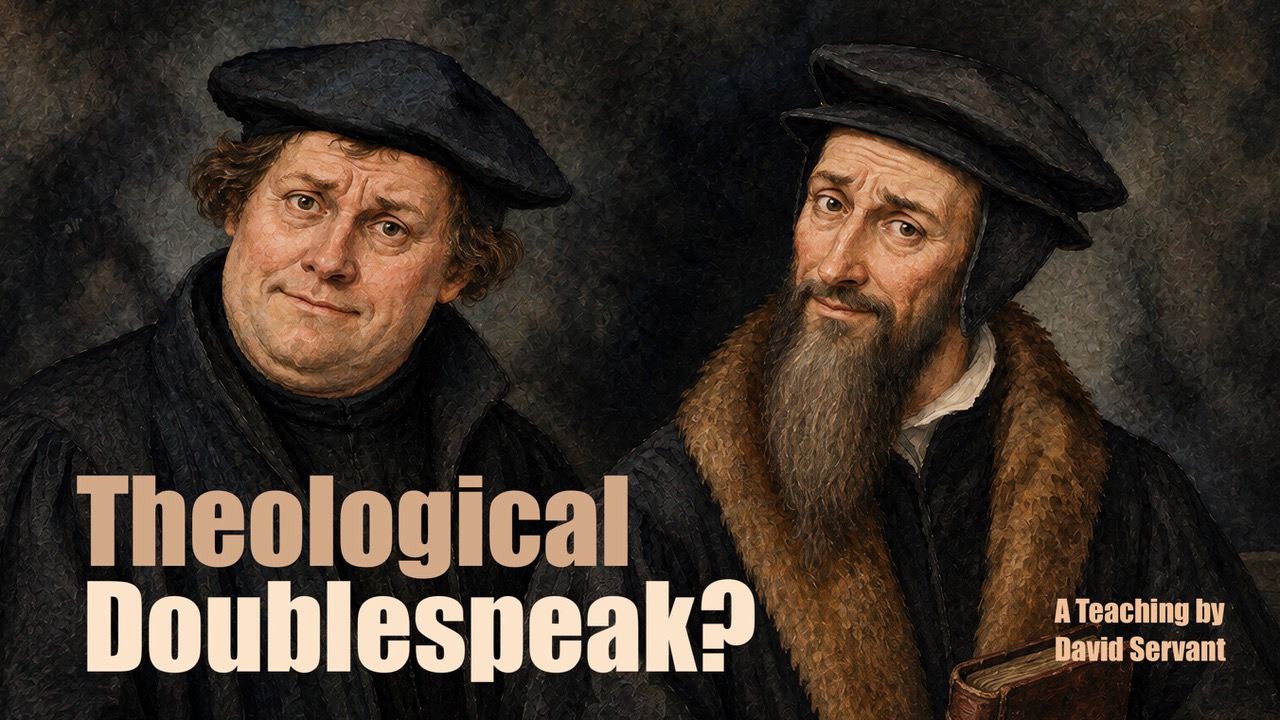
You have likely heard this quote from Martin Luther: “We are saved by faith alone, but the faith that saves is never alone."
About 25 years later (AD 1547), John Calvin similarly wrote, “It is therefore faith alone which justifies, and yet the faith which justifies is not alone.”
Both theologians were trying to explain the relationship between faith, works, and salvation. They believed that salvation is “by faith alone,” yet they also held that genuine faith in Jesus always produces “works”—that is, obedience to His commandments.
To many people, however, their statements sound like doublespeak. In the first clause, the faith that saves is alone, but in the second clause it is not. Am I to believe that my works have nothing to do with my salvation because salvation is by faith alone, yet my faith must be evidenced by works or else it is not genuine? That sounds as though works actually do have something to do with my salvation. Luther’s and Calvin’s statements appear self-contradictory. I am not the first person to have pointed this out over the past 500 years.
If someone said, “We get from point A to point B by cars alone and not by motors, but only by cars that have motors,” I would wonder about that person. I would assume he was confused.
Or if someone said, “We are saved from dying in a burning house by faith alone and not by running outside, yet the faith that saves us is always accompanied by the act of running outside,” I would again wonder about the person. Why is he trying to convince me that faith alone will save me from dying in a burning house when it is obvious from his own claim that he does not actually believe that himself? Again, I would assume he was confused.
There could be a thousand similar examples cited. If A is faith, B is works, and C is salvation, it cannot be true that A – B = C and A + B = C. To say otherwise is doublespeak.
The apostle James, whose letter Martin Luther referred to as “an epistle of straw,” was certainly not confused on this point. James plainly said in a summarizing statement, “You see that a man is justified by works and not by faith alone” (James 2:24). That, by the way, is the only place in the entire Bible where the words “faith” and “alone” appear in the same sentence. And James plainly declared, “A man is justified by works and not by faith alone.” In light of that, I have never been able to understand how the Protestant mantra “We are justified by faith alone” ever got off the ground and has survived to this day. It could not more directly contradict James 2:24.
Protestant theologians have done their best to explain that apparent contradiction, and those explanations can be both entertaining and tragic. They sometimes try to argue that the “justification” James was writing about was “justification before men” rather than “justification before God,” as if James’ readers needed correction on that issue for some odd reason. But even Martin Luther—who actually added the word “alone” to his German translation of Romans 3:28 (“For we maintain that a man is justified by faith apart from works of the Law”), knowing full well the word was not in the Greek text—never so twisted James 2:24. One reason he gave for labeling James an “epistle of straw” was because he believed James 2:14–26 seemed to ascribe justification to works in a way that conflicted with Paul’s teaching of justification by faith apart from works. Luther clearly understood James to be writing about justification before God (not before men), and anyone who reads the passage honestly will reach the same conclusion.
In any case, people have been trying to reconcile James and Paul on this issue for a long time. We all agree that two inspired writers cannot contradict each other. During the several times James and Paul met (Galatians 1:18–19; 2:1–10; Acts 15; 21:17–26), we can be sure they did not debate this issue. So any apparent contradiction must stem from our own lack of understanding. In my opinion, the apparent contradiction is largely explained by the different audiences of Paul and James and the specific errors each was correcting.
Paul wrote primarily to Gentile or mixed churches that were dealing with pressure from the “Judaizers,” who were teaching that Gentiles needed to be circumcised and keep the Mosaic Law in its entirety in order to be saved. In Paul’s letter to the Galatians, for example, circumcision is mentioned thirteen times. Here is one example that also reveals Paul’s perfect harmony with James:
For in Christ Jesus neither circumcision nor uncircumcision means anything, but faith working through love (Gal. 5:6, emphasis added).
Paul did not write “faith alone” but “faith working through love.” That is the same kind of faith James described—a faith demonstrated by works. Never once in any of his letters did Paul use the phrase “faith alone.” And there are plenty of passages in his letters that make it crystal clear that he believed a standard of holiness is required for ultimate salvation. One of them appears in the same letter to the Galatians:
Now the deeds of the flesh are evident, which are: immorality, impurity, sensuality, idolatry, sorcery, enmities, strife, jealousy, outbursts of anger, disputes, dissensions, factions, envying, drunkenness, carousing, and things like these, of which I forewarn you, just as I have forewarned you, that those who practice such things will not inherit the kingdom of God (Gal. 5:19-21, emphasis added).
How dishonest it is when teachers quote Galatians 2:16 (“a man is not justified by the works of the Law but through faith in Christ Jesus”) to persuade people that obedience has nothing to do with salvation and that anyone who says otherwise is a heretic, while ignoring Galatians 5:19–21, which clearly declares the opposite. They not only pit Paul against James; they pit Paul against Paul and unwittingly label him a heretic in the process.
In contrast to Paul, who wrote primarily to Gentile and mixed churches, James wrote to Jewish believers living outside Israel (see James 1:1). His letter was most likely written between AD 45 and 49, making it one of the earliest—if not the earliest—books of the New Testament. Very few, if any, of the well-known later Gentile churches (such as those in Galatia or Ephesus) yet existed. So there was no pressing problem of Judaizers trying to persuade Gentile believers that they must be circumcised in order to be saved.
All of this is to say that James addressed a different problem to a different audience. That problem is identical to the one so prevalent in many Protestant churches today: the idea that holiness is not part of the salvation equation because faith is nothing more than a mental doctrinal acknowledgment, and grace has been reduced to a license to sin. Here is what the Holy Spirit has to say about that through James:
What use is it, my brethren, if someone says he has faith but he has no works? Can that faith save him? (Jas. 2:14)
The obvious answer to that rhetorical question is “No.”
If a brother or sister is without clothing and in need of daily food, and one of you says to them, “Go in peace, be warmed and be filled,” and yet you do not give them what is necessary for their body, what use is that? (Jas. 2:15-16).
It is interesting that James uses an analogy drawn from Jesus’ foretelling of the judgment of the sheep and the goats to illustrate work-less faith that does not save. We can safely say regarding Matthew 25:31–46 that the sheep had faith and the goats did not. It was evident by their works.
Even so faith, if it has no works, is dead, being by itself (Jas. 2:17, emphasis added).
One way to paraphrase that sentence would be, “Even so, faith alone is dead.” So why is anyone saying that we are “saved by faith alone”?
But someone may well say, “You have faith and I have works; show me your faith without the works, and I will show you my faith by my works” (Jas. 2:18)
That is simple, irrefutable, Spirit-given logic. And it couldn’t be more relevant to the multitudes whose faith is actually faith in their doctrine of “faith alone” rather than faith in a divine Person who gives commandments and who has promised to repay everyone according to their deeds.
You believe that God is one [a cardinal Jewish doctrine]. You do well; the demons also believe, and shudder (Jas. 2:19).
Even demonic “faith” is demonstrated by works!
But are you willing to recognize, you foolish fellow, that faith without works is useless? Was not Abraham our father justified by works when he offered up Isaac his son on the altar? You see that faith was working with his works, and as a result of the works, faith was perfected; and the Scripture was fulfilled which says, “And Abraham believed God, and it was reckoned to him as righteousness,” and he was called the friend of God. You see that a man is justified by works and not by faith alone (Jas. 2:20-24).
It is interesting that James cited two events in Abraham’s life, recorded in Genesis 15 and 22, that occurred roughly 40 to 50 years apart. James declared that God’s reckoning of Abraham’s faith as righteousness (Genesis 15:6) was fulfilled when he offered up Isaac (Genesis 22). James can only mean that Abraham’s obedience regarding Isaac was a demonstration of the faith by which God had credited him as righteous decades earlier. Whether we fully understand all the implications or not, James’ conclusion could not be clearer: “You see that a man is justified by works and not by faith alone.” Yet just about any evangelical pastor who made the same claim from his pulpit today would risk losing his job for heresy.
It is also interesting that Paul similarly quoted Genesis 15:6 (“Then [Abram] believed in the Lord; and He reckoned it to him as righteousness”) in Romans 4:3 and Galatians 3:6 when arguing that Abraham was justified by faith apart from works. Again, however, he was addressing a different issue to a different audience. The context of both Romans 4 and Galatians 3 reveals that the primary issue was the error of requiring Gentile circumcision for salvation. And do not forget that it is in Romans that Paul twice mentioned the “obedience of faith” (Romans 1:5; 16:26) and also wrote:
But because of your stubbornness and unrepentant heart you are storing up wrath for yourself in the day of wrath and revelation of the righteous judgment of God, who will render to each person according to his deeds: to those who by perseverance in doing good seek for glory and honor and immortality, eternal life; but to those who are selfishly ambitious and do not obey the truth, but obey unrighteousness, wrath and indignation. There will be tribulation and distress for every soul of man who does evil, of the Jew first and also of the Greek, but glory and honor and peace to everyone who does good, to the Jew first and also to the Greek. For there is no partiality with God (Rom. 2:5-11).
In the end, the biblical picture is not one of faith versus works, nor of faith plus works as two separate ingredients. It is the picture of a living faith that works—faith that is never alone because it is always accompanied by the obedience that genuine faith produces. James and Paul do not contradict each other; they complement each other.
If teachers have infiltrated your church and are telling Gentiles that they must be circumcised and keep the Mosaic Law in its entirety to be ultimately saved, read Paul and rebuke those teachers. If your pastor is teaching that faith alone (by itself) will save you, find a church whose pastor has read James. The faith that justifies produces the fruit of obedience, and it perseveres in doing good. Only that kind of faith is genuine.
Food for thought!