In case you didn’t realize it, we’ve started our ascent, and you’ve already left the crowds behind. In fact, just by reading the previous lesson—in which I enumerated Jesus’ three requirements for discipleship (found in Luke 14:25-33)—you started on an upward path that most avoid. I didn’t mention it in that previous lesson, but when Jesus enumerated those three requirements, He told His audience to first count the cost:
For which one of you, when he wants to build a tower, does not first sit down and calculate the cost to see if he has enough to complete it? Otherwise, when he has laid a foundation and is not able to finish, all who observe it begin to ridicule him, saying, “This man began to build and was not able to finish.” Or what king, when he sets out to meet another king in battle, will not first sit down and consider whether he is strong enough with ten thousand men to encounter the one coming against him with twenty thousand? Or else, while the other is still far away, he sends a delegation and asks for terms of peace (Luke 14:28-32).
Clearly, Jesus was not promising an easy path. There is a cost to being His disciple, one that should be carefully considered beforehand. Jesus implied in Luke 14:25-33 that it could cost one his family members, his comfort and convenience, his money and possessions, and even his life. But He also promised that there would be a reward at the end that would far exceed any earthly price paid: “Rejoice and be glad, for your reward in heaven is great” (Matt. 5:12). The apostle Paul echoed: “For I consider that the sufferings of this present time are not worthy to be compared with the glory that is to be revealed to us” (Rom. 8:18). If you stay with me on this journey, you will be glad you did. Guaranteed.
This may shock you, but the truth is, those whom you’ve left behind are unbelievers. Those who truly believe in Jesus follow Him, regardless of the cost. Believers obey. It is that simple. That is why Paul wrote about “the obedience of faith” (Rom. 1:5; 16:26). That is why Jesus’ message was a consistent call to obedience. He preached repentance, which is the initial step of obedience (Matt. 4:17; 11:20; 12:41; Mark 1:15; Luke 10:13; 11:32; 13:3, 5; 15:7, 10). He called people to take His yoke upon themselves, an obvious metaphor for making Him Master. He warned that “Not everyone who says to Me, ‘Lord, Lord,’ will enter the kingdom of heaven, but he who does the will of My Father who is in heaven will enter” (Matt. 7:21). All that I have just described is the essence of believing in Jesus. Living faith results in committed obedience (Jas. 2:14-26).
How does inviting people to “accept Jesus” harmonize with all I have just described? It doesn’t. That is why A.W. Tozer wrote:
If your Christian conversion did not reverse the direction of your life, you are simply a victim of the “accept Jesus” heresy… The Lord will not save those whom He cannot command. He will not divide His offices. You cannot believe on a half-Christ.
This is why the most difficult group to evangelize is “born-again Christians.” I am speaking, of course, of those who are convinced that they are safe in God’s grace because they once prayed a prayer for salvation in some form. They imagine that saving faith consists of mentally acknowledging (and not actually believing) some theological facts that revolve around Jesus’ death and resurrection.
Saving faith, however, is faith in a divine Person. Jesus said, “For God so loved the world, that He gave His only begotten Son, that whoever believes in Him shall not perish, but have eternal life” (John 3:16).
It is those who believe in Jesus who will inherit eternal life. To believe in Him is to believe, not only what He said, but also in who He is. And who is He? More than anything else, He is Lord. He is referred to as Lord over 600 times in the New Testament. Compare that with the mere 16 times that He is referred to as “Savior.”
When the Philippian jailer asked Paul and Silas, “What must I do to be saved?” (Acts 16:30), they did not respond, “Just accept Jesus as your personal Savior.” No, they said, “Believe in the Lord Jesus, and you will be saved” (Acts 16:31, emphasis added). Praise God, that jailer did believe in the Lord Jesus, and his genuine faith soon became evident as he washed Paul and Silas’ wounds and prepared a meal for them (Acts 16:33-34). Faith works through love (see Gal. 5:6.)
All of this is to say, your continuing on this journey is a good indication of what has happened and is still happening in your heart. So let us “press on toward the goal for the prize of the upward call of God in Christ Jesus” (Phil. 3:14).
Two Kinds of Greed
By way of brief review, we’ve previously learned that we can’t serve two masters. Specifically, according to Jesus, we can’t serve God and money. In a practical sense, that means we must obey God in money matters, both in money’s acquisition and use.
To obey God in money matters is to serve and love Him as Master. To disobey God in money matters is to serve and love money, which makes money one’s master. That is no doubt why the apostle Paul equated greed with idolatry (Eph. 5:5; Col. 3:5). Here again is the equation I shared in our first lesson:
Disobeying God in regard to money/possessions = God is not loved and is not master = Money is loved and is master = Greed = Idolatry
We’ve also learned that there are at least two forms of greed. One revolves around how money is acquired. The other revolves around how money is used. Theft is a form of greed because it is a transgression of God’s commandment to love one’s neighbor as oneself in regard to the acquisition of money. Similarly, not sharing with the poor is a form of greed because it is a transgression of God’s commandment to love one’s neighbor as oneself in regard to the use of money.
In this lesson, we are going to take a look at a man who was guilty of both forms of greed and repented of both. His name was Zaccheus, and only Luke recorded his story:
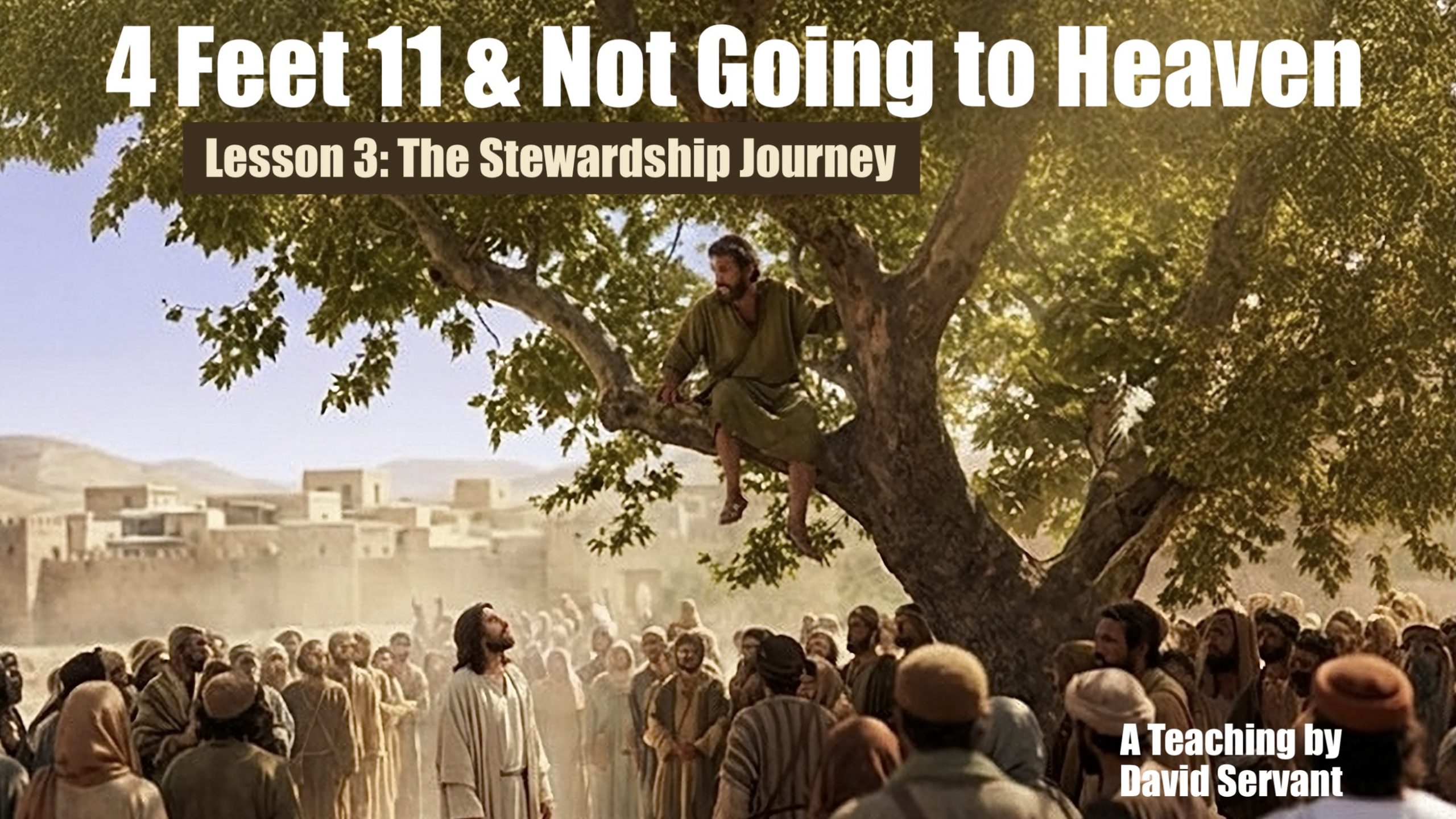
[Jesus] entered Jericho and was passing through. And there was a man called by the name of Zaccheus; he was a chief tax collector and he was rich. Zaccheus was trying to see who Jesus was, and was unable because of the crowd, for he was small in stature. So he ran on ahead and climbed up into a sycamore tree in order to see Him, for He was about to pass through that way. When Jesus came to the place, He looked up and said to him, “Zaccheus, hurry and come down, for today I must stay at your house.” And he hurried and came down and received Him gladly. When they saw it, they all began to grumble, saying, “He has gone to be the guest of a man who is a sinner.” Zaccheus stopped and said to the Lord, “Behold, Lord, half of my possessions I will give to the poor, and if I have defrauded anyone of anything, I will give back four times as much.” And Jesus said to him, “Today salvation has come to this house, because he, too, is a son of Abraham. For the Son of Man has come to seek and to save that which was lost” (Luke 19:10).
As a chief tax collector for the hated, occupying Roman Empire, Jewish Zaccheus would have acquired his position by out-bidding others in Jericho for the right to collect a fixed amount for Rome with the knowledge that any surplus could be kept as profit for himself. He would have hired other tax collectors to help him reach his quota, which could have been achieved only by means of some form of enforcement by local Roman soldiers. The whole system incentivized over-collection and corruption, so Zaccheus would not only have been considered to be a traitor by his countrymen, but also a thief. And he was wealthy because of it.
Jesus, however, came “to seek and to save that which was lost” (Luke 19:10), and Zaccheus certainly fit the description. Prior to Jesus’ arrival in Jericho, he was a lover of money. It was his god and master. He was guilty of both forms of greed. He not only acquired his money through illicit means but he also neglected the poor. Had he died prior to his encounter with Jesus, he would have been rightly condemned to hell with all other greedy people (Eph. 5:3-5; Col. 3:5-6). He was four feet eleven—and not going to heaven.
Zaccheus only hoped to see Jesus as He passed by. He never expected that Jesus would call him by name, much less inform him that He and his disciples would be staying at his house—which may well have been the biggest house in Jericho. I wonder if the fact that Jesus didn’t ask Zaccheus if he could lodge at his house, but rather acted like He had the right to stay—as only an owner would—helped Zaccheus think about his stewardship before God? Or, had Zaccheus heard something of what Jesus had been teaching, and that is what brought him to repentance? Or could it simply have been that his conscience had been speaking to him all of his life, convicting him of his greed? Did Jesus’ healing of blind Bartimaeus just a short time earlier grip his heart?
Regardless, Zaccheus was quite happy about Jesus’ decision to lodge at his house. Not understanding much about God’s grace, everyone else in the crowd who knew something about Zaccheus grumbled that Jesus was about to “be the guest of a man who is a sinner.” Momentarily, however, that would all change when Zaccheus publicly repented of his greed. He repented of both forms, saying, “Lord, half of my possessions I will give to the poor, and if I have defrauded anyone of anything, I will give back four times as much” (Luke 19:8).
Although the Mosaic Law did stipulate that thieves who were caught pay additional restitution, the only fourfold restitution required was in the case of stolen sheep that had been killed or resold (Ex. 22:1). Nevertheless, Zaccheus certainly displayed his sincere repentance regarding his former fraud.
Neither was giving half of one’s possessions to the poor stipulated in the Mosaic Law. But again, Zaccheus was demonstrating his change of heart towards those whom he had previously ignored. Whatever remained after that liquidation, along with what remained after the fourfold restitution of that which he had gained fraudulently, Zaccheus was a lot less wealthy. He was, however, finally “rich toward God” (Luke 12:21) and ready to stand before Him.
True Salvation
I’m sure you noticed that Jesus didn’t discourage Zaccheus in his zeal. On the contrary, Jesus saw Zaccheus’ change of heart as a sign of his salvation.
Zaccheus was saved “by grace through faith,” which is the only way anyone has ever been saved in the history of humanity. He believed in Jesus so he repented, just as Jesus had been telling everyone to do.
God’s grace forgave all his former sins, but it didn’t grant Zaccheus a license to continue sinning. How do you suppose Jesus would have responded if Zaccheus had said, “Jesus, I accept you as my personal Savior. Thank you for your amazing grace which allows me to continue defrauding my countrymen and neglecting widows and orphans!”? I can assure you that Jesus would not have affirmed his salvation, and for one simple reason—because Zaccheus’ words and actions would have demonstrated that he didn’t actually believe in Jesus.
That being so, what are we to think of those today who “pray a sinner’s prayer for salvation” yet who make no attempt to make restitution for former wrongs or who continue to ignore the plight of the poor? The person who keeps what he has knowingly stolen is still a thief, and the New Testament warns that no thief will inherit God’s kingdom:
Or do you not know that the unrighteous will not inherit the kingdom of God? Do not be deceived; neither fornicators, nor idolaters, nor adulterers, nor effeminate, nor homosexuals, nor thieves, nor the covetous, nor drunkards, nor revilers, nor swindlers, will inherit the kingdom of God (1 Cor. 6:9-10).
And the person who continues to ignore the plight of the poor is still guilty of another form of greed, as he disobeys God in regard to the use of his money, indicating that he loves and serves, not God, but money. John wrote:
We know that we have passed out of death into life, because we love the brethren. He who does not love abides in death…. We know love by this, that He laid down His life for us; and we ought to lay down our lives for the brethren. But whoever has the world’s goods, and sees his brother in need and closes his heart against him, how does the love of God abide in him? Little children, let us not love with word or with tongue, but in deed and truth (1 John 3:14-18).
Perhaps you, like most of us who live in what I often refer to as “Disney World,” don’t know or have contact with anyone, much less any Christian, who is so poor that they lack basic necessities like food or covering. But are you aware that such people exist outside of Disney World? You probably are. In a later lesson, I will share how you can best connect with them to help them.
John’s Baptism of Repentance
Since we are on the subject of sincere repentance and subsequent salvation, let’s ascend just a little further up the stewardship path and pause to take a look at the ministry of John the Baptist. His baptism was a “baptism of repentance for the forgiveness of sins” (Mark 1:4; Luke 3:3). That is, God was offering forgiveness to those who would repent. (That has always been God’s gracious offer.)
John didn’t believe that baptism alone, or even that confession of sin was sufficient. Genuine repentance—a change of behavior—was essential. He boldly preached to those who were lining up to be baptized:
You brood of vipers, who warned you to flee from the wrath to come? Therefore bear fruits in keeping with repentance, and do not begin to say to yourselves, “We have Abraham for our father,” for I say to you that from these stones God is able to raise up children to Abraham. Indeed the axe is already laid at the root of the trees; so every tree that does not bear good fruit is cut down and thrown into the fire” (Luke 3:7-9, emphasis added).
John, speaking on behalf of God, called for fruit, that is, an observable change of behavior. He wanted disobedience replaced with obedience. Those whose behavior didn’t change would be “thrown into the fire,” a clear reference to hell.
Matthew recorded a part of John’s preaching that Luke did not, and it certainly underscored this same message:
As for me, I baptize you with water for repentance, but He who is coming after me is mightier than I, and I am not fit to remove His sandals; He will baptize you with the Holy Spirit and fire. His winnowing fork is in His hand, and He will thoroughly clear His threshing floor; and He will gather His wheat into the barn, but He will burn up the chaff with unquenchable fire” (Matt. 3:11-12).
After the harvest, chaff is the lightweight outer husks that surround the edible wheat kernels. In ancient times, farmers separated the worthless chaff from the valuable wheat kernels through a process called winnowing. After threshing (beating or trampling the harvested stalks to loosen the grains), they would toss the mixture into the air with a fork or fan, allowing the wind to blow away the light chaff while the heavier wheat grains fell back down. Again, John’s message was clear. God is looking for fruit. Chaff is destined for the fire.
When the convicted crowds asked John what they should do to show the sincerity of their repentance with fruit, he responded with six directives that targeted different groups:
And the crowds were questioning him, saying, “Then what shall we do?” And he would answer and say to them, “The man who has two tunics is to share with him who has none; and he who has food is to do likewise.” And some tax collectors also came to be baptized, and they said to him, “Teacher, what shall we do?” And he said to them, “Collect no more than what you have been ordered to.” Some soldiers were questioning him, saying, “And what about us, what shall we do?” And he said to them, “Do not take money from anyone by force, or accuse anyone falsely, and be content with your wages” (Luke 3:10-14).
Did you notice that five of John’s six directives concerned money?
Three had to do with the selfish (greedy) acquiring of money. He told the repentant tax collectors (1) not to collect more than they had been ordered to collect.[1]. He told the repentant soldiers (2) not to take money from anyone by force (theft) and (3) to be content with their wages. Their discontentment was the likely cause of their theft.[2].
Two of John’s directives had to do with the selfish (greedy) use of money. John told everyone who owned two tunics to (1) share with someone who had no tunic. He told everyone who had food to (2) share with someone who had no food. So even those who had very little were expected to help those with nothing.
Obviously, John’s six directives did not comprise everything that all of John’s convicted audiences could have done, or would do in the future as they matured in their faith. But John gave them some basic, initial behavioral changes to make to authenticate their profession of repentance, and it is noteworthy that at least five of those six directives revolved around forms of greed. For that reason, it is to be regretted that many who are reading these words have professed to be Christians for years, but they are only now being exposed to truth that John’s converts heard on Day 1. But better late than never!
The All-Important Questions: Have I “accepted Jesus” or “believed in the Lord Jesus”? Have I repented of both forms of greed, and is there fruit in my life to prove it? Have I made restitution, if possible, for anything I knowingly gained fraudulently? Am I sharing some of what God has entrusted to me with the poor?
[1] It is noteworthy that John did not tell tax collectors or soldiers to quit their jobs. Jesus also did not expect Zaccheus to quit his job.
[2] And perhaps John’s directive to soldiers not to “accuse anyone falsely” also had something to do with their means of theft. If it did, then six out of six directives had something to do with money.