Who may ascend into the hill of the Lord?
And who may stand in His holy place?
He who has clean hands and a pure heart,
Who has not lifted up his soul to falsehood
And has not sworn deceitfully.
He shall receive a blessing from the Lord
And righteousness from the God of his salvation (Ps. 24:3-5).
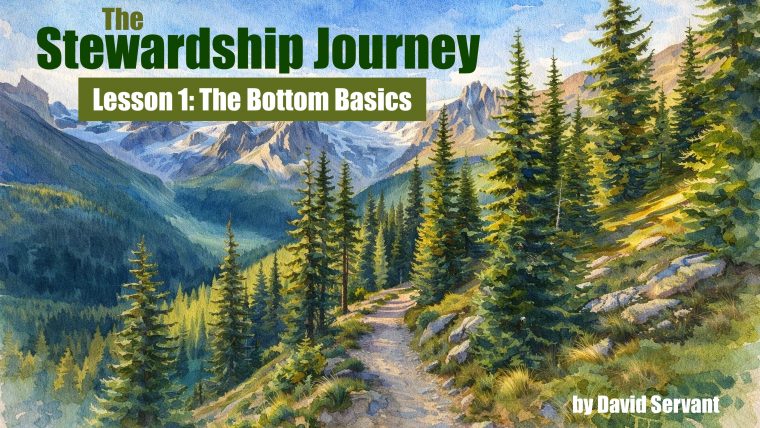
If there’s one hobby that’s stayed with me my entire life, it’s hiking. I’ve always been drawn to scenic beauty, and the finest trails deliver it in generous doses, with sweeping mountain vistas along the way. The very best hikes promise a spectacular summit payoff. There is nothing like a breathtaking, panoramic view achieved through determination and perseverance.
A few summers ago, my wife and I were blessed to spend a week exploring some of Western Canada’s iconic national parks. Our most unforgettable hike was the Plain of Six Glaciers Trail in Banff. It begins on the shore of glacier-fed Lake Louise, whose turquoise waters—milky from glacial silt—draw awed visitors from around the world. The shoreline path is usually bustling with tourists, but the crowds thin quickly once the trail begins its ascent up the valley.
Over the next five miles or so, with roughly 1,800 feet of elevation gain, we pressed through pristine alpine forests, anticipation (and weariness) growing with every switchback. Those who, like us, reached the trail’s end found a quiet, rocky perch to sit and absorb the grandeur: close-up views of Victoria Glacier clinging to the peaks, the vast moraine stretching below, and—far in the distance—tiny Lake Louise shimmering like a distant jewel.
There, amid a sacred silence, fellow hikers share a wordless camaraderie. Foot-weary and fatigued, they know they’ve earned a sublime privilege, enjoyed only by those willing to climb.
The Stewardship Journey—on which we are about to embark—parallels that hike in at least three ways. First, only a committed minority chooses to break from the crowds and fix their eyes on a higher aspiration. Second, the ascent isn’t easy—but it’s filled with unexpected beauty and surprising revelations along the path. And third, the payoff at the peak is spectacular, and even more so than the overlook of Victoria Glacier. It is heavenly!
With all of that in mind, let’s begin our ascent.
God’s View
The Bible consistently presents all of humanity as divided into two fundamental groups—and often by using stark contrasts in moral, spiritual, and eternal terms.
For example, Scripture speaks of the righteous and the wicked, children of God and children of the devil, believers and unbelievers, spiritual persons and natural persons, those in light and those in darkness (Matt. 13:49; Acts 24:15; 1 John 3:10; 2 Cor. 6:15; 1 Cor. 2:14–15; 2 Cor. 4:6; Eph. 5:8).
Jesus Himself illustrated this same division through parables and a foretelling: wheat and tares, the lost and the found, good fish and bad fish, sheep and goats (Matt. 13:24–43; Luke 15:1–32; Matt. 13:47–50; 25:31–46).
Ultimately, every person falls eternally into one category or the other—welcomed into heaven or cast into hell. There is no middle or third category.
This biblical dichotomy does not deny that there are degrees of righteousness or wickedness; the Bible clearly affirms some variation within each group. Wealthy Job stands out as the most righteous man of his day, of whom God declared, “There is no one like him on the earth, a blameless and upright man, fearing God and turning away from evil” (Job 1:8). Likewise, King Ahab of Israel is singled out for exceptional wickedness: he “did evil in the sight of the Lord more than all who were before him” (1 Kin. 16:30).
Still, Scripture leaves no room for ambiguity: every person falls into one category or the other.
We are either wicked or righteous. We are either children of God or children of the devil. The apostle John wrote that it isn’t difficult to determine into which category we, and others, belong:
By this the children of God and the children of the devil are obvious: anyone who does not practice righteousness is not of God, nor the one who does not love his brother. (1 John 3:10).
The two telling tests are straightforward and unmistakable. They are based on obedience and love. It is so simple that only a theologian could misunderstand. Yet John anticipated that there would be misunderstanding on this very point because of deceptive teachers. Just moments earlier he warned:
Little children, make sure no one deceives you; the one who practices righteousness is righteous, just as He is righteous. (1 John 3:7, emphasis added).
This plain teaching, and so many others like it in the New Testament, contradicts the claim that one can somehow be righteous in God’s sight through Christ while continuing in unrighteous living. That ancient and modern heresy is soundly debunked throughout the Bible, as we will see.
The Initial Test
The Stewardship Journey starts by determining if we are children of God or children of the devil. To make that determination, we only need to ask ourselves a simple question in light of John’s two tests (referenced above in 1 John 3:10): Is my life characterized by obedience to God and love for fellow believers?
If your honest self-examination leads you to answer “yes,” then you pass the test.
This does not mean you must claim perfection. If you are like me, you realize that you still have room to grow. We all could be more obedient and loving. The New Testament’s many admonitions to obedience—directed at believers—imply there is room to improve. That is also why John wrote these reassuring words:
If we confess our sins, He is faithful and righteous to forgive us our sins and to cleanse us from all unrighteousness (1 John 1:9).
Righteous people may still need cleansing from occasional unrighteousness. The test in 1 John 3:10 is not about flawless performance but about the direction and pattern of life that separates us from those who have not repented and believed in the Lord Jesus Christ. Writing about his own journey towards perfect obedience that he had not yet attained, Paul wrote:
Not that I have already obtained it or have already become perfect, but I press on so that I may lay hold of that for which also I was laid hold of by Christ Jesus. Brethren, I do not regard myself as having laid hold of it yet; but one thing I do: forgetting what lies behind and reaching forward to what lies ahead, I press on toward the goal for the prize of the upward call of God in Christ Jesus (Phil. 3:12-14).
On the other hand, if your honest self-examination based on 1 John 3:10 leads you to answer “no,” then you have failed the test. You can, however, immediately fix that by doing what we all once had to do—repent and believe in the Lord Jesus Christ. If you will, you will be immediately transferred from the category of the wicked to the righteous, because God will not only forgive every sin you’ve ever committed, but He will also deposit His Holy Spirit in you to lead, guide and empower you to obey Him. It’s the best deal you’ve ever been offered. Take it! And then join the rest of us as we ascend together on our Stewardship Journey.
God or Mammon?
Jesus mentioned one other scriptural contrast that divides people—that of serving God or money. According to Him, it is impossible to serve both:
No one can serve two masters; for either he will hate the one and love the other, or he will be devoted to one and despise the other. You cannot serve God and wealth (Matt. 6:24).
Let’s carefully consider those two sacred sentences.
First, notice Jesus portrayed God as a master to be loved and devotedly to serve. That is Christianity 101. Any portrayal of God that suggests He is anything less than a master who is worthy to be loved and served is heretical and blasphemous. Anyone who advocates that one can have a relationship with God apart from devoted obedience to Him is a false teacher.
Second, don’t allow the word wealth, as it is translated in the New American Standard Version, to lead you to think that Jesus was speaking only about large sums of money. Both the NIV and ESV use the word money instead of wealth. The Ancient Greek word Jesus used, mamōnas, is a transliteration of an Aramaic word which, in everyday Aramaic usage simply meant wealth, riches, money, possessions, or material gain.
Jesus personified mamōnas, portraying it as a rival master to God. Obviously, inanimate money does not decree commandments as God does. That being so, the only way money could be considered to be one’s master is if one disobeys any of God’s commandments in relation to money or possessions. That is important to grasp.
For example, because God forbids theft, one who steals money disobeys God, and this reveals that money, not God, is his master.
Or, because God forbids deception, one who deceives in order to gain money disobeys God and reveals that money, not God, is his master.
Both of those examples are also examples of a form of greed, which Paul, taking his cue from Jesus, twice labeled as idolatry (Col. 3:5; Eph. 5:5).
Greed is revealed by any disobedience of God’s commandments regarding money and possessions. All of this will become clearer in future lessons, but for now just remember the formula below that is simply a paraphrase of Jesus’ and Paul’s words that I’ve just referenced above:
Disobeying God in regard to money/possessions = God is not loved and is not master, but rather is hated and despised = Money is loved and is master = Greed = Idolatry
Our Stewardship Journey must begin with an examination of ourselves in this regard. If gaining money, whether it be a little or much, requires any moral compromise or disobedience of God, it is idolatrous, because money, not God, is master. This is no small matter. Paul solemnly warned that greedy persons—who are inherently idolatrous—will not inherit God’s kingdom:
But immorality or any impurity or greed (Greek noun: pleonexia) must not even be named among you, as is proper among saints…. For this you know with certainty, that no immoral or impure person or covetous (Greek adjective: pleonektes) man, who is an idolater, has an inheritance in the kingdom of Christ and God (Eph. 5:3-5, emphasis added).
Note that Paul was warning Christian believers, indicating that he not only believed that they could act greedily, but that by being greedy they could forfeit inheriting the kingdom of God. To honest readers, both of those facts are indisputable.
Dishonest preachers, however, often attempt to persuade their gullible audiences that Paul’s warning about not “inheriting God’s kingdom” has nothing to do with heaven or ultimately being saved. Yet in other epistles, Paul undeniably used the phrase “inherit the kingdom” in reference to heaven and ultimate salvation (see 1 Cor. 6:9; 15:50; Gal. 5:21).
Moreover, so did Jesus in His foretelling of the judgment of the sheep and goats. To the sheep on His right He will say, “Come, you who are blessed of My Father, inherit the kingdom prepared for you from the foundation of the world” (Matt. 25:34, emphasis added). They will inherit “eternal life” (Matt. 25:46).
Some may object with the claim that “salvation is by grace, so there cannot be any behavioral requirement for heaven.” Such people certainly haven’t been reading the New Testament very closely, nor do they understand biblical grace, which is never unconditional, but always conditional. Paul wrote that we are saved “by grace through faith.” This proves that saving grace is conditional. The condition of saving grace is faith. If saving grace was unconditional, not requiring faith, everyone would be automatically saved.
God’s conditional saving grace was illustrated in Jesus’ encounter with the woman caught in the act of adultery as told by the apostle John in his Gospel. Jesus said to her, “I do not condemn you, either. Go. From now on sin no more” (John 8:11). Even though she deserved to die, He graciously gave her an opportunity to repent. I hope that she seized that opportunity before she did eventually die, because the New Testament warns that no adulterer will inherit God’s kingdom (see 1 Cor. 6:9-10; Gal. 5:19-21; Eph. 5:3-5). The grace that Jesus offered her was conditional, and it was the same grace offered to everyone through the gospel. Paul wrote:
For the grace of God has appeared, bringing salvation to all men, instructing us to deny ungodliness and worldly desires and to live sensibly, righteously and godly in the present age, looking for the blessed hope and the appearing of the glory of our great God and Savior, Christ Jesus, who gave Himself for us to redeem us from every lawless deed, and to purify for Himself a people for His own possession, zealous for good deeds (Tit. 2:11-14, emphasis added).
If greed can prevent us from inheriting eternal life, self-examination in that regard is certainly in order. So, before you continue to the next lesson, please take time for that self-examination. I also recommend memorizing and meditating on Jesus’ solemn warning in Matthew 6:24:
No one can serve two masters; for either he will hate the one and love the other, or he will be devoted to one and despise the other. You cannot serve God and wealth.
The Stewardship Journey begins with making Jesus one’s Master, which requires the forsaking of all other masters. No one can serve two masters. If Jesus is not your Master, you don’t actually believe in Him yet, because He is both Lord and Master (Jude 4). You may think you believe in Him, but all you have actually done is carved an idol and named it “Jesus.” The apostle Jude warned about “ungodly persons who turn the grace of our God into licentiousness [a license to sin].” In so doing, they “deny our only Master and Lord, Jesus Christ” (Jude 4).
So you must settle this, and there is no sense taking another step on our journey until you do!
For to this end Christ died and lived again, that He might be Lord both of the dead and of the living (Rom. 14:9).