Psychology is the scientific study of how people think, feel, and behave, as well as the biological, social and environmental factors that influence those processes.
I have no doubt that people have benefited from academic psychology, as contrasted with “pop psychology,” which is not validated by a rigorous application of the scientific method. Pop psychology oversimplifies the complexities of academic (or clinical) psychology.
You can find pop psychology in abundance all over the internet, and it can be harmful to those who innocently employ it to self-diagnose. Tragically, pop psychology has also infiltrated what is often palmed off as clinical psychology by credentialed psychologists who adopt therapeutic techniques that lack empirical support.[1]
That being said, I have personally benefited from evidence-based psychology. I learned, for example, from the late Dr. James Dobson—who always described himself as a “Christian psychologist”—that “behavior that is rewarded tends to recur.” So, my wife and I were careful that we didn’t reward our young children for behavior that we didn’t want to recur. For example, when they wanted something and kept whining to get it, we didn’t reward them by ultimately giving them what they were whining for, as that would only result in more future whining. Had we given in, we would have been teaching them that the way to get what they want is by continued whining. Conversely, we always tried to reward good behavior with praise and sometimes other rewards. And it worked, just like Dr. Dobson said it would. (By the way, it works on adults as well, and God uses that same principle to motivate His own children.)
There is, however, one very grave danger that I’ve observed regarding modern psychology, and Dr. Dobson would have agreed with me. Because psychology’s fundamental premise is that people’s behavior is shaped by a combination of genetics, environment, and social interaction (which is all undeniably true to some extent), personal responsibility is mitigated and accountability to God doesn’t exist. No secular psychologist ever said to someone whom he was counseling, “Your problem is that you aren’t doing what Jesus commanded.” Yet in so many cases, that would be God’s diagnosis.
There is no such thing as “sin” in modern psychology, and guilt is often viewed negatively. That makes it fundamentally godless, and thus something which Christians ought to approach with acute caution. The closest thing to sin in psychology is “anti-social behavior.” And psychologists place the blame for it on genetic, environmental and social factors. The solutions they offer to those they counsel don’t include the word “repentance.”
For these reasons, the danger exists for life-altering self-deception among those who seek help from psychologists. “I’m a victim!” can become the dominating thought—a thought that Satan loves to feed. “My troubles are not my fault. The blame for my negative thinking, feelings, and behaviors lies outside of me.” Once that conclusion is reached, it becomes easy to think that the solution is to negate those blameworthy external influences.
Dr. Dobson warned about that very thing. He routinely told his listeners: “Secular counselors treat symptoms; biblical counselors treat the heart.” Any system that lets people blame parents, society, or “low self-worth” instead of confessing sin was, to him, dangerous counterfeit help.
Please allow me to interject that the pendulum can sometimes swing to the other extreme—when people who are victims of some form of abuse become wrongly convinced (usually by their abuser) that they are to blame. A wise counselor can be an invaluable help to those who are caught in that web of deception, helping them to see more clearly.
Personally, I’ve suffered both extremes. I can recall one very difficult time in my life when I was certain I was a victim, but I realized at a later time that I was mostly to blame. And I can recall another time when I was confused in just the opposite way, thinking that I must be blind to my faults that others could see, but later realized my fault-finders had been misled by a treacherous mutual friend.
In any case, we all can use help from others when we struggle to see clearly. If you are currently in the midst of such a struggle, I encourage you to seek biblical counsel from a caring friend, rather than the counsel of a therapist or psychologist who is apt to ignore your responsibility and accountability to God. Paid therapists have a financial incentive to avoid saying anything to you that would keep you from returning for another session. When we need clarity, we are best served by wise friends who love us enough to tell us the truth. “Faithful are the wounds of a friend, but deceitful are the kisses of an enemy” (Prov. 27:6).
As a side note, I can’t help but wonder why, among high-paid professions (those who earn at least $100,000 per year), psychologists have the highest divorce rate. The folks who are supposed to be the experts regarding human behavior and relationships have the highest rate of failure in the closest human relationship that exists. Could it be because they are apt to place blame on their spouses rather than themselves?
I also can’t help but wonder if godless psychology is what is confusing so many people on basic issues of justice. What is influencing so many people to view criminals as the victims and victims as the criminals? When God is removed from your worldview, something perverse is bound to replace Him.
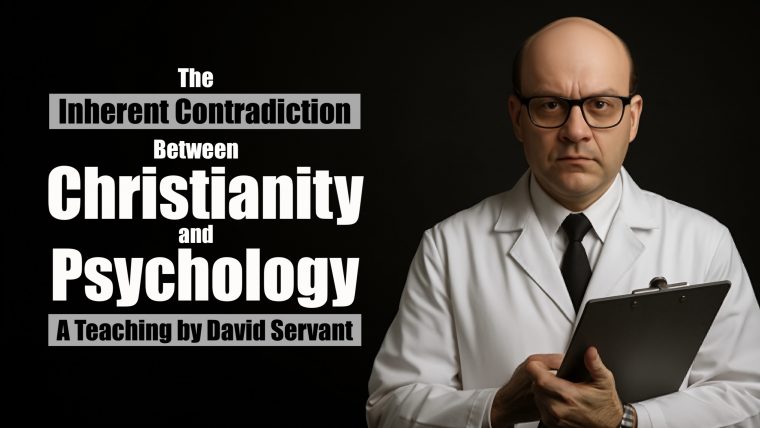
In any case, if you are a follower of the Lord Jesus Christ, I think you can see the inherent contradiction between modern psychology and Christianity. The Bible emphasizes personal responsibility and accountability to God over any other factors that might contribute to negative (sinful) behavior. Just a cursory reading of Scripture reveals that. Murder is murder, regardless of your skin color, neighborhood, or what anyone has done to you in the past. The same is true for adultery, fornication, greed, hatred, idolatry, unforgiveness, and any and every other moral sin listed in the Bible.
Think about this: What are the chances a psychologist will counsel you to “love your enemies” or warn you that, if you don’t forgive your brothers from your heart, God won’t forgive you of your sins, but rather will reinstate your formerly-forgiven sins and turn you over to the torturers (as Jesus solemnly warned in the Parable of the Unforgiving Servant). Pretty slim chance, I suspect. You are more likely to be offered counsel that is based on some psychological theory which may or may not have any scientific basis or real therapeutic value. What is tragic about all of this is that Jesus offers everyone who is “weary and heavy-laden” the opportunity to take His yoke upon themselves and “find rest for their souls” (Matt. 11:29-30). He offers emotional health and freedom, not by giving us justifications for our wrong behavior or by shifting blame, but through confession and forgiveness. It is wonderful grace.
In my humble opinion, those particular words of Jesus recorded in Matthew 11:29-20 are some of the best the Bible has to offer for anyone struggling under the weight of emotional burdens. Taking Jesus’ yoke is of course symbolic of making Him your master and submitting to His will. The remedy for so many ills is simply obeying Jesus. And lest anyone misunderstand His metaphor, Jesus quickly added that His “yoke is easy and His burden is light.” His point is that we all have our choice of burdens. We can choose His light and easy burden or the heavy and wearisome burden of disobedience. It’s a no-brainer!
May I also ask, what are the chances a secular psychologist will acknowledge that Satan or evil spirits might be lying to you or oppressing your mind in some way? There is no chance. Neither will he point you to the Word of God to help you recognize and identify Satan’s lies. Nor will he show you that the New Testament instructs Christians to only think about what is true, honorable, right, pure, lovely, of good repute, excellent and worthy of praise (see Phil. 4:8). (What an emotional difference is made in the lives of those who obey those instructions!) Nor will he point out that those who are indwelt by God’s Holy Spirit have the potential to enjoy all the Spirit’s beautiful fruit: love, joy, peace, patience, kindness, goodness, faithfulness, gentleness and self-control. The only thing that can stop that fruit from manifesting and maturing in believers is disobedience.
Secular psychologists may indeed help some people understand why they think, feel and behave as they do, and in turn help them overcome negative thinking, feelings and behaviors. But God offers so much more.
But what about Christian counselors who are psychologists, like the late James Dobson?
If they are Christians, as Dr. Dobson was, God’s unchanging Word will take precedence over the latest version of the Diagnostic and Statistical Manual of Mental Disorders, which is the “Bible” of all secular psychologists. Dr. Dobson hated godless psychology, and so should anyone hate what contradicts God’s Word. To believe in God is to believe His Words. To love God is to love His Words. To please God is to obey His Words.
God made us. God knows us. God has told us what to do. It is His will that anyone and everyone who is “weary and heavy laden” “find rest for their souls” by “taking His yoke.” But the choice is always ours. He won’t force us. So just do it!
[1] For proof, see House of Cards: Psychology and Psychotherapy Built on Myth, by Robyn M. Dawes, who served for many years as head of the Department of Social and Decision Sciences at Carnegie Mellon University.
