We should never think that there is anything inherently evil about being wealthy. Perhaps the best biblical support for that claim is the Old Testament figure Job. He was, in his day, the most righteous person on earth. God Himself said of Job: “There is no one like him on the earth, a blameless and upright man, fearing God and turning away from evil” (Job. 1:8). For that reason, it would seem safe to assume that Job was not guilty of any form of greed.
Yet Job was very wealthy. We read in the biblical book by his name: “His possessions also were 7,000 sheep, 3,000 camels, 500 yoke of oxen, 500 female donkeys, and very many servants; and that man was the greatest of all the men of the east” (Job 1:3). Job was a multi-millionaire. His wealth in livestock alone was about $34 million by current valuations. We can’t help but wonder about the value of everything else he may have owned, such as real estate. Amazingly, after Job’s trials, God restored to him double what he lost (Job 42:10).
Job was obviously a gifted businessman and leader. He likely had to employ hundreds of people to run his operation, and he must have treated them fairly in order to win the Lord’s highest approbation. Although Job had “very many servants” (Job 1:3), he could not be accused of exploiting them, and he said so (see Job 31:13-15). There was no greed in how he acquired his wealth—unlike the rich people whom the apostle James condemned in his epistle:
Come now, you rich, weep and howl for your miseries which are coming upon you… Behold, the pay of the laborers who mowed your fields, and which has been withheld by you, cries out against you; and the outcry of those who did the harvesting has reached the ears of the Lord of Sabaoth (Jas. 5:1, 4).
Moreover, there was no greed in how Job utilized his wealth. In his humility, Job waited until the end of his long debate with his three friends to reveal the details of his compassionate and generous lifestyle:
For when the ear heard, it called me blessed,
And when the eye saw, it gave witness of me,
Because I delivered the poor who cried for help,
And the orphan who had no helper.
The blessing of the one ready to perish came upon me,
And I made the widow’s heart sing for joy.
I put on righteousness, and it clothed me;
My justice was like a robe and a turban.
I was eyes to the blind
And feet to the lame.
I was a father to the needy,
And I investigated the case which I did not know.
I broke the jaws of the wicked
And snatched the prey from his teeth (Job 29:11-17).
If I have despised the claim of my male or female slaves
When they filed a complaint against me,
What then could I do when God arises?
And when He calls me to account, what will I answer Him?
Did not He who made me in the womb make him,
And the same one fashion us in the womb?
If I have kept the poor from their desire,
Or have caused the eyes of the widow to fail,
Or have eaten my morsel alone,
And the orphan has not shared it
(But from my youth he grew up with me as with a father,
And from infancy I guided her),
If I have seen anyone perish for lack of clothing,
Or that the needy had no covering,
If his loins have not thanked me,
And if he has not been warmed with the fleece of my sheep,
If I have lifted up my hand against the orphan,
Because I saw I had support in the gate,
Let my shoulder fall from the socket,
And my arm be broken off at the elbow.
For calamity from God is a terror to me,
And because of His majesty I can do nothing (Job 31:13-23).
Had Job not been so wealthy, he could not have been near the blessing that he was to so many poor and marginalized people. For that reason, gaining wealth can be considered virtuous if it is gained without greed and if it is utilized to serve others. Included in that service to others is offering them employment. (In fact, as we will consider in a later lesson, employing people to work is far superior to giving them handouts.)
A Second Good Man
In previous lessons, we’ve looked at the stories of three wealthy men. We’ve considered the damning decision of a foolish farmer in Jesus’ Luke 12 parable, the redeeming resolution of Zaccheus the Jericho tax collector, and the heartless indifference of a purple-robed pig at whose gate Lazarus starved and died. All of those stories are found only in Luke’s Gospel. Luke was obviously inspired to record them to help Bible readers—like us—to examine ourselves and make the right choices.
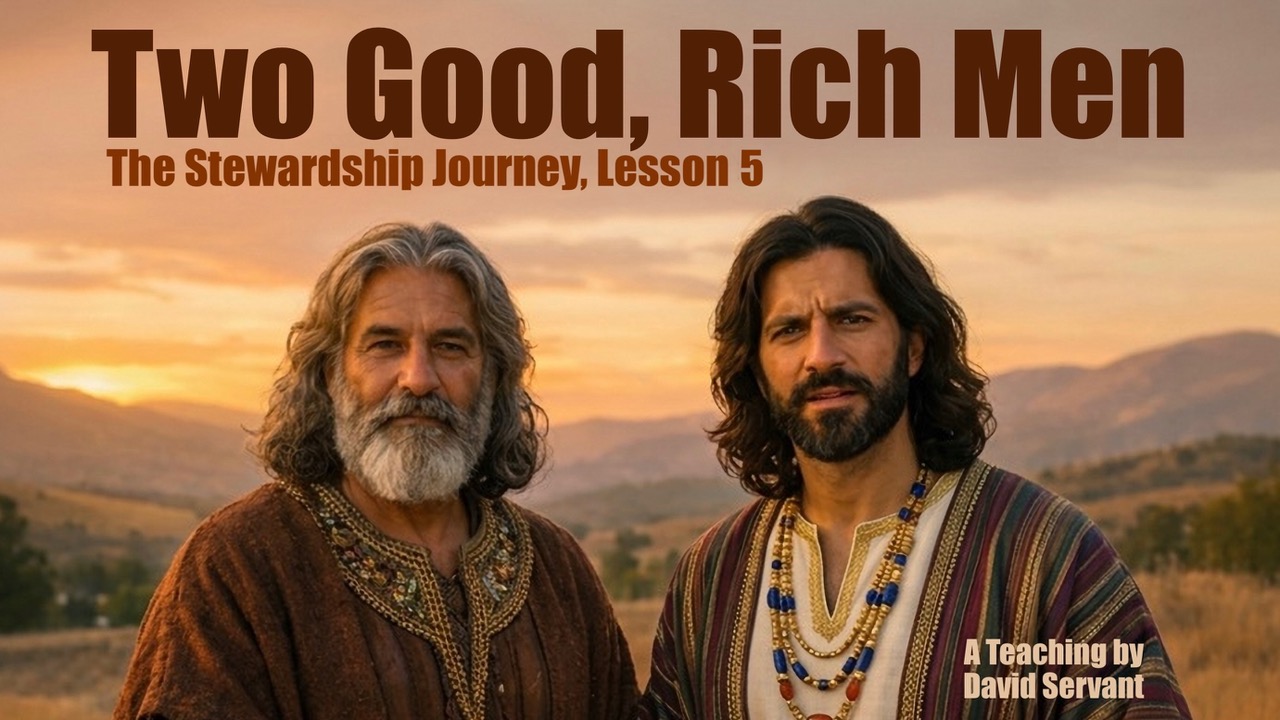
There is one story, however, that is also very relevant to our topic of stewardship that is found in three Gospels—the story of the rich young ruler (Matt. 19:16-30; Mark 10:17-31; Luke 18:18-30). The Holy Spirit inspired Matthew, Mark and Luke to include it in their accounts, and it would seem safe to think it was because of its importance.
Each of the three accounts include details not included by the others. When all three are compiled, they paint a picture of a sincere, good, but ultimately conflicted man. What leads me to characterize him as sincere and good? Here are four biblical indications:
First, we learn from Luke that he was a “ruler.” Because he was Jewish and not Roman, we can be sure that he was, at most, a community or synagogue leader. In either case, his position indicates that he was highly respected in his community, as he was likely elected.
Second, we learn from Matthew that he was young. That makes his position as a community leader, and possibly as a spiritual leader, even more remarkable, as his culture would have favored “elders” for such positions.
Third, we also learn from Matthew that he highly respected Jesus as a teacher, indicated by the fact that he literally ran to Him and then knelt before Him to pose his question (Matt. 10:17). His humility was extraordinary.
Fourth, all three Gospel authors tell us that he asked the most important question that anyone could ask: “Good Teacher, what shall I do to inherit eternal life?” (Mark 10:17; Luke 18:18). He believed that eternal life was available, and He believed Jesus would know how he could inherit it.
Those four factors all add up to reveal that, at least by human standards, the young rich ruler was a sincere and good man. And there is still more supporting evidence to come in the narrative.
In contrast to my appraisal, Jesus first responded to the rich man’s sincere question by asking, “Why do you call Me good? No one is good except God alone” (Mark 10:18; Luke 18:19). We can be sure Jesus was not downplaying His own goodness or divinity, because He never sinned, and He was God in the flesh. He could not have been correcting the young man, so as to say, “I don’t deserve to be called good.” Perhaps he was subtly suggesting that the young man think about who He might actually be, or prodding him to think about humanity’s general deficiency of goodness.[1]
The Six Commandments
Jesus then directly answered the rich man’s question by saying, “If you wish to enter into life, keep the commandments” (Matt. 19:17), to which he responded by asking, “Which ones?” (Matt. 19:18). Jesus then listed five of the Ten Commandments: “You shall not commit murder; you shall not commit adultery; you shall not steal; you shall not bear false witness; honor your father and mother.”
Jesus then added one additional commandment which, at another time, He declared was second only to the commandment to love God with all one’s heart, mind, soul and strength (Mark 12:28-31) and which the apostle Paul later said sums up all the commandments (Rom. 13:8-10), namely, “You shall love your neighbor as yourself.” It stands to reason that, if keeping five lesser commandments is required to inherit eternal life, keeping any greater commandment would also be required. In any case, Jesus listed six commandments in total[2], including one that summarized the other five.
Taken at face value, according to Jesus, keeping those six commandments guaranteed eternal life. And to the chagrin of false-grace teachers who claim that what Jesus told the young ruler has no relevancy for those saved “by grace through faith” (Eph. 2:8) under the New Covenant, it is indisputable that four of the six commandments Jesus enumerated are also mentioned in the New Testament epistles as being essential to keep for ultimate salvation. John wrote that (1) “no murderer has eternal life” (1 John 3:15) and that (2) all liars would be cast into the lake of fire (Rev. 21:8). Paul wrote that (3) no adulterer or (4) thief will inherit God’s kingdom (1 Cor. 6:9-10). That’s four of Jesus’ six. And once again, it would not be logical to think that keeping one commandment that is greater than those four (loving neighbor as oneself) would not also be essential for eternal life.[3]
Hearing Jesus’ six essential commandments, the young ruler replied, “Teacher, I have kept all these things from my youth up” (Mark 10:20). Mark then records Jesus’ reaction: “Looking at him, Jesus felt a love for him” (Mark 10:21).
At that point, it would seem reasonable to think the rich man would have been convinced he was on the right path. Jesus listed six essential commandments related to inheriting eternal life, and the young man sincerely believed he’d kept them all from his youth. Jesus didn’t debate him, but rather “felt a love for him,” which would seem to be more of an indication of agreement and approval rather than disagreement and disapproval. If the young man’s self-appraisal was accurate, both he and Jesus believed that he was on the path to eternal life. That could have been the end of their discussion.
Their conversation, however, was not over, because after the young man said, “All these things I have kept,” he added, “What am I lacking?” (Matt. 19:20). His declaration, followed by a question, could be variously interpreted. Here are three possibilities:
1.) “I believe I’ve been meeting those qualifications for eternal life since my youth; but perhaps I’m wrong, and if I am, can you enlighten me?”
2.) “I believe I’ve been meeting those qualifications since my youth, but I don’t believe you’ve actually told me all that is required to inherit eternal life. What other requirements are there?”
3.) “I believe I’ve been meeting those six qualifications since my youth, so you’ve given me assurance that I’m on the path to eternal life. Now, is there anything else I can do that would gain God’s favor?”
The first possibility strains what the rich man actually said. He confidently stated: “All these things I have kept from my youth.”
The second possibility portrays the rich man—who ran to Jesus, knelt before Him, and addressed Him as “good teacher”—as doubting Jesus’ answer to his question. That would seem unlikely.
The third possibility seems most likely, and especially because of how Jesus responded to his question: “If you wish to be complete, go and sell your possessions and give to the poor, and you will have treasure in heaven; and come, follow Me” (Matt. 19:21, emphasis added). There are at least four reasons why that third possibility is the most reasonable:
1.) Although there are plenty of biblical reasons to believe that the six initial commandments Jesus listed are requirements for eternal life, there is nothing in Scripture that would lead us to think that selling all of one’s possessions and giving the proceeds to the poor is a requirement for eternal life. (There are biblical reasons to believe, however, that caring for the poor is a requirement for eternal life, if from nothing else than the commandment to love one’s neighbor as oneself.)
2.) Jesus had already answered the rich man’s question. He enumerated six commandments that must be kept to inherit eternal life. Are we to think Jesus was now moving the goal post?
3.) Jesus said, “If you wish to be complete” (or “perfect” or “mature” as the Greek word teleios is often translated; see Matt. 5:48; 1 Cor. 13:10; 14:20; Eph. 4:13). That indicates how Jesus interpreted the young man’s question. He did not think the rich man was asking what he lacked to inherit eternal life, but what he lacked to be complete, perfect or mature. Mature believers, of course, are mature in love, so they care for the poor and are thus laying up as much treasure in heaven as they possibly can.
If the young man had been loving his neighbor as himself since his youth as he claimed (and Jesus didn’t dispute him), he had already been sharing some of what he gained with his neighbors who were poor. But to be complete, perfect or mature required greater love and sacrifice, and it was a sacrifice he was unwilling to make, as we will soon see.
4.) There is no sense in laying up treasure in heaven if you aren’t headed there. At this point in their conversation, Jesus told the rich young man what he should do to lay up treasure in heaven, implying that he was heading there. That being so, could Jesus perhaps have meant, “It’s great that you are on the path to heaven. But you are a rich man who is laying up most of his treasure on earth. When you die, you will be leaving it on earth when you could have sent it ahead where it would never be lost. But you can begin turning that around today”?
The Lack of One Thing
Mark’s truncated account of this part of Jesus’ encounter with the rich ruler recorded Him saying: “One thing you lack” followed by, “go and sell all that you possess and give to the poor, and you shall have treasure in heaven; and come, follow Me” (Luke 18:22). Although Jesus told him that he lacked one thing, He told him to do three things: (1) sell all his possessions, (2) distribute the proceeds to the poor, and (3) “follow Me.”
It seems reasonable to think that “one thing” he lacked was to follow Jesus, and that dispossession and distribution to the poor were necessary steps to attain that “one thing.” For that reason, some suggest that the rich man’s possessions required so much of his attention that they prevented him from literally following Jesus, and that is why Jesus told him to dispossess. That may very well be true. It is not necessarily true, however, for all other wealthy people. In fact, many utilize the businesses they own to generate income that benefits God’s kingdom as they follow Jesus every day.
In any case, keep in mind that following Jesus—in the sense of literally following Him all over ancient Israel—was not and is not essential for eternal life, as proven by, if nothing else, Jesus’ answer to the rich man’s initial question. That answer included the necessity of keeping six commandments, and Jesus said nothing at first about following Him. Literally following Jesus, however, would have been a wonderful opportunity for the rich man that certainly would have paid off spiritually. So, again, all of this seems to be evidence that Jesus was not telling him what he must do to inherit eternal life, but what he must do to have the most rewarding life and eternity.
Think about it this way: Loving the young man (Mark 10:21) and appreciating his years of obedience, Jesus offered him a way to never lose the wealth he would undoubtedly forfeit eventually, as well as an opportunity to follow Him, listen to His teaching, and witness some miracles. It was the opportunity of a lifetime, of centuries, and of eternity.
The Application
Tragically, the rich young man turned down Jesus’ offer: “When he had heard these things, he became very sad, for he was extremely rich” (Luke 18:23). “He went away grieving, for he was one who owned much property” (Matt. 19:22; Mark 10:22). He did not want to dispossess.
Jesus’ disciples had been listening to the conversation, and while they all watched the rich man walk sadly away, Jesus seized the opportunity to share His perspective of what they were witnessing:
And Jesus, looking around, said to His disciples, “How hard it will be for those who are wealthy to enter the kingdom of God!” The disciples were amazed at His words. But Jesus answered again and said to them, “Children, how hard it is to enter the kingdom of God! It is easier for a camel to go through the eye of a needle than for a rich man to enter the kingdom of God.” They were even more astonished and said to Him, “Then who can be saved?” Looking at them, Jesus said, “With people it is impossible, but not with God; for all things are possible with God” (Mark 10:23-27).
First, that paragraph dispels the idea that Jesus’ words only had application to one man in human history, namely the rich young ruler. Jesus believed they had application to all wealthy people. His disciples believed they had application to themselves.
Second, it seems reasonable to think that Jesus’ disciples were amazed at His words because they had always assumed, and for sound, biblical reasons, that wealth was a sign of God’s blessing. Yet Jesus was declaring that entering God’s kingdom would be especially difficult for the wealthy. That was contradictory to what they previously thought.
Third, because Jesus’ disciples were amazed at His words, it stands to reason that this was the first time they heard anything like them during their previous three-and-a-half years of following Him. (Jesus’ encounter with the rich ruler occurred no more than a few weeks prior to His crucifixion.) Although Jesus consistently taught of the necessity of caring for the poor (as we have seen), He had never intimated that rich people had to completely dispossess on behalf of the poor to inherit eternal life. We must therefore ask, Is that what He meant? Or could He have meant something else?
Here is a possibility: If Jesus didn’t move the goal post, and if, therefore, keeping the six commandments He first listed was sufficient to inherit eternal life, and if the rich man’s self-appraisal was accurate, then he was not forfeiting eternal life as he walked sadly away. Rather, he was forfeiting treasure in heaven. And upon his arrival in heaven, he would fully realize it. Having left his treasure on earth, he would have left his heart there as well, as Jesus warned: “For where your treasure is, there your heart will be also” (Matt. 6:21). That truth doesn’t change depending on one’s location. If one can be on earth but his heart be in heaven, then one can be in heaven but his heart be on earth. Imagine, if you will, entering heaven but longing to return to earth! Jesus indicated that entering God’s kingdom for the rich ruler would be analogous to a camel going through the eye of a needle—certainly not easy for the camel!
If total dispossession on behalf of the poor was essential for inheriting eternal life, Jesus could have simply said, “It is impossible for rich people—as well as middle-class, lower-class, and anyone who is not poor—to be saved unless they completely dispossess on behalf of the poor.”
But Jesus didn’t say that. Rather, He spoke about how especially difficult it will be for the rich to enter God’s kingdom, as illustrated by a camel passing through the eye of a needle. Why did He specify a camel rather than a sheep or donkey? Perhaps because of its size, but camels also have a widespread reputation for being particularly stubborn among animals that humans have historically used for work, riding, or packing. Imagine trying to persuade a camel to attempt to squeeze through the eye of a needle! He will not cooperate, preferring to stay right where he currently is. Again, when those who have left most of their treasure on the earth realize that they could have stored all or most of it in heaven, it is safe to think they will be full of regret. Given the chance, they would immediately return to earth to dispossess, but that won’t be an option.
Again, Jesus did not say, “It is easier for a camel to go through the eye of a needle than for a rich man to be saved.” He said, “Truly I say to you, it is hard for a rich man to enter the kingdom of heaven. Again I say to you, it is easier for a camel to go through the eye of a needle, than for a rich man to enter the kingdom of God” (Matt. 19:23-24, emphasis added). Entering the kingdom of heaven is a future event for those of us still on the earth. Recall Jesus’ warning in His Sermon on the Mount:
Not everyone who says to Me, “Lord, Lord,” will enter the kingdom of heaven, but he who does the will of My Father who is in heaven will enter. Many will say to Me on that day, “Lord, Lord, did we not prophesy in Your name, and in Your name cast out demons, and in Your name perform many miracles?” And then I will declare to them, “I never knew you; depart from Me, you who practice lawlessness” (Matt. 7:21-23, emphasis added).
Jesus was referring to a future time when certain people would be hoping to literally enter heaven, but they will hear God inform them that they can’t enter. And although it will be impossible for those who “practice lawlessness” to enter the kingdom of heaven (and even for those who have performed miracles), it will not be impossible for people like the rich young ruler. When Jesus’ disciples asked in alarm, “Then who can be saved?”[4] Jesus gave them hope: “With people it is impossible, but not with God; for all things are possible with God” (Mark 10:27). I’m inclined to think Jesus was referring, at least in part, to what He would be accomplishing within days through His sacrificial death and resurrection—that would make possible forgiveness and a transformation that turns lovers of money into lovers of God. No one can be saved apart from God making possible what would otherwise be impossible.
The Promise
Perhaps somewhat relieved by Jesus’ words but still concerned, Peter, speaking for himself and the others, said, “Behold, we have left everything and followed You; what then will there be for us?” They had not dispossessed and distributed all their earthly wealth to the poor, but they had left everything behind to follow Jesus. Would they inherit eternal life? Would there be any treasure in heaven for them? Jesus’ answer should have calmed their fears and filled them with joy:
Truly I say to you, that you who have followed Me, in the regeneration when the Son of Man will sit on His glorious throne, you also shall sit upon twelve thrones, judging the twelve tribes of Israel (Matt. 19:28).
But that was not all:
Truly I say to you, there is no one who has left house or brothers or sisters or mother or father or children or farms, for My sake and for the gospel’s sake, but that he will receive a hundred times as much now in the present age, houses and brothers and sisters and mothers and children and farms, along with persecutions; and in the age to come, eternal life (Mark 10:29-30).
Jesus’ disciples would be rewarded in both this life and the next, because “God is a rewarder of those who seek Him” (Heb. 11:6). Earthly blessings and eternal life awaited them.
In regard to Jesus’ promise of a hundred-fold return, He was not promising them ownership of one hundred houses or farms any more than He was promising them one hundred mothers, fathers or children. He was promising them a big spiritual family that would welcome them into their homes as they traveled to spread the gospel.
In Summary
How did the apostles and early church interpret Jesus’ words, found in three Gospels, to the rich young ruler? Although we can read in the book of Acts about the early believers dispossessing on behalf of the poor among them (see Acts 2:44-45; 4:32-37), their dispossession was voluntary rather than obligatory or essential for salvation, as indicated by Peter’s words to Ananias in Acts 5:4 regarding his free choice to sell his land. And there is no mention of anyone fully dispossessing.
Moreover, although Paul attempted to persuade the Corinthian believers to put aside money every week on behalf of poor and suffering believers in Jerusalem (see 1 Cor. 16: 1-4; 2 Cor. 8-9), he also wrote to them:
If I have all faith, so as to remove mountains, but do not have love, I am nothing. And if I give all my possessions to feed the poor…but do not have love, it profits me nothing (1 Cor. 13:2-3).
Note that Paul mentioned two lofty aspirations that are both based on Jesus’ words, namely mountain-moving faith and total dispossession on behalf of the poor. Paul’s implication is that both are rarely attained. His words certainly don’t imply that full dispossession is required for salvation. That doesn’t mean, however, Paul thought wealthy believers (like most everyone reading this) could safely ignore the poor. He wrote to Timothy:
Instruct those who are rich in this present world not to be conceited or to fix their hope on the uncertainty of riches, but on God, who richly supplies us with all things to enjoy. Instruct them to do good, to be rich in good works, to be generous and ready to share, storing up for themselves the treasure of a good foundation for the future, so that they may take hold of that which is life indeed (1 Tim. 6:17-19).
There is a lot packed in that passage. Let’s not miss anything.
First, note that Paul believed there were those in the church who were “rich in this present world,” which implied that they may not be rich in the next world.
Such folks should “do good” and “be rich in good works.” More specifically, they should “be generous and ready to share.” If they would, they would “store up for themselves the treasure of a good foundation for the future.” Of course, if they would not, they would not “store up for themselves the treasure of a good foundation for the future”. By the way, it is clear that Paul was borrowing Jesus’ words regarding storing up treasures in heaven.
Most importantly, notice Paul’s final clause: “…so that they may take hold of that which is life indeed.” That is, if the rich will be generous and store up treasure in heaven then (and only then) will they “take hold of that which is life indeed.”
The phrase “life indeed” can be variously interpreted, but it must have something to do with a superior quality of life. Since storing up treasure in heaven has something to do with attaining “life indeed,” it would seem reasonable to think it involves a superior quality of life for eternity. Of course, if we interpret that phrase in light of the rest of the New Testament (including everything we’ve considered in earlier lessons), we can be sure that caring for the poor is essential for obtaining eternal life, and perhaps eternal life is the “life indeed” Paul was referencing.
Although those who have been inebriated by the idea of an unconditional grace ignore all the New Testament’s injunctions that hinge holiness to salvation, those who believe everything in the New Testament do not assume they can sin with impunity. They know they must “Pursue the holiness without which no one will see the Lord” (Heb. 12:14) and “work out their salvation with fear and trembling” (Phil. 2:12).
Just seconds before Paul told Timothy to instruct the rich to be generous in order that they might “take hold of life indeed,” he told Timothy himself to “Pursue righteousness, godliness, faith, love, perseverance and gentleness [and to] fight the good fight of faith” that he might “take hold of the eternal life” to which he was called (1 Tim. 6:12). The Greek word translated “take hold” (epilambano) in that sentence is the identical word translated “take hold” that Paul used three sentences later regarding the necessity of the rich to be generous that they might “take hold” of “life indeed.” So, by obedience, we can “take hold” of both “eternal life” and “life indeed.” Worth thinking about!
The All-Important Questions: Am I at all like the rich young ruler, doing well spiritually by the most basic metrics and on the path to eternal life, but still able to be a greater blessing and store up more treasure in heaven? Am I “taking hold of life indeed” by my generosity? Am I “taking hold of eternal life” by my obedience? When my time comes to enter heaven, will any of my heart still be on the earth?
[1] In contrast to Jesus’ comment that “no one is good except God alone” is God’s praise of Job’s righteousness that we’ve already considered, the Genesis testimony that “Noah was a righteous man, blameless in his time” (Gen. 6:9), as well as Luke’s statements that Zacharias and his wife, Elizabeth, “were both righteous in the sight of God, walking blamelessly in all the commandments and requirements of the Lord” (Luke 1:6), that wealthy Joseph of Arimathea was “a good and upright man” (Luke 23:50), and that the apostle Barnabas was a “good man” (Acts 11:24). Other similar biblical character assessments could be cited.
[2] Mark’s account adds one commandment not mentioned in Matthew and Luke, namely, “Do not defraud,” which would seem to be a subset set of “Do not steal.”
[3] Those who claim that there are no behavioral requirements required for eternal life because “salvation is by grace” pervert the actual biblical truth that “salvation is by grace through faith,” which indicates that saving grace is not unconditional but conditional, and that the condition is faith. Moreover, they ignore the biblical truths that, apart from works, faith is “dead” and “cannot save” (Jas. 2:14-26), and that faith must be continued to be effectual for ultimate salvation (see Col. 1:21-23; 1 Cor. 15:1-2; Heb. 3:14; 10:36-39). They also disregard all the warnings in the New Testament epistles regarding sinful behaviors that, if practiced, can cause those who practice them to forfeit inheriting God’s kingdom (such as Gal. 5:19-21; Eph. 5:3-5; 1 Cor. 6:9-10). Those who genuinely believe in Jesus strive to obey Him, because He is their Lord.
Some claim that Jesus enumerated commandments, not because He believed they were actually required standards for inheriting eternal life, but because He hoped to get the man to realize he was a sinner who broke those commandments so that he would see his need to “accept Jesus as his Savior and receive the free gift of salvation that has no behavioral requirements.” So Jesus told the man to keep six commandments in order to inherit eternal life in hopes that he would realize that keeping those commandments is not required to inherit eternal life! What a perverse twisting of this story.
[4] Which makes me think that they were mistakenly interpreting Jesus’ words to be about obtaining salvation rather than treasure in heaven.