
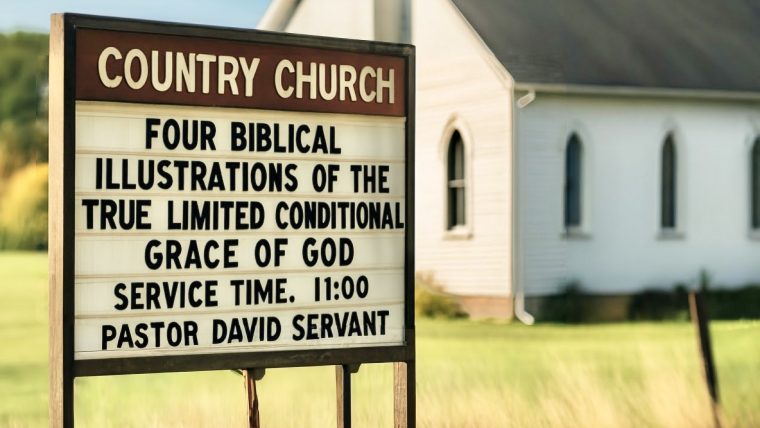
In light of Jesus’ lordship, His grace must be limited to some degree. If, for example, Jesus was offering a license to sin by His grace, that would void His lordship. How could He be Lord if He has no behavioral expectations for His servants (whom He owns)?
Yet some professing Christian teachers advocate that Jesus’ grace is, in fact, a license to sin. They would never say it using those words, but they say it in other words.
For example, some claim there is nothing any Christian could do that would result in the forfeiture of his or her salvation. That, clearly, is a license to sin. It is a claim that, if I as a Christian become a serial rapist and murderer, it would not affect the status of my ultimate salvation. Worse, such teachers claim that if there is any behavioral requirement for salvation, that is equivalent to advocating “salvation by works,” and to nullifying “salvation by grace.”
That, however, is faulty logic. Jesus portrayed His Father as being a gracious Lord and King, but one whose grace is limited and conditional.
For example, you probably remember Jesus’ Parable of the Unforgiving Servant. The king’s servant owed him an insurmountable debt. The servant begged for mercy, and the king graciously forgave him of his entire debt. That was pure grace on the part of the king. However, when his forgiven servant refused to forgive a fellow servant who owed him some money, the king became very angry. So, the king’s grace was not unlimited. He was not offering his forgiven servant a license to sin. In fact, he reversed His previous grace, reinstated his servant’s formerly-forgiven debt, and had him cast into prison until his debt was repaid. Here’s how Jesus ended that parable:
And his lord, moved with anger, handed him over to the torturers until he should repay all that was owed him. My heavenly Father will also do the same to you, if each of you does not forgive his brother from your heart (Matt. 18:34-35).
Was Jesus warning His unforgiving servants of some temporal, earthly discipline, or was He warning of forfeiture of salvation? Keep in mind that the servant’s debt was immense. Jesus said it was 10,000 talents (Matt. 18:24). In His day, it would take a laborer fifteen years to earn just one talent. Clearly, Jesus was trying to illustrate an unpayable debt. And that debt, which was previously forgiven, was reinstated. The king’s slave was no longer forgiven of his insurmountable debt. So, are unforgiven people ultimately saved?
Moreover, the now-unforgiven servant was “handed over to the torturers until he should repay” his debt in full. How could he ever hope to repay if he was being tortured until he repaid? Again, it seems there would be no hope of repayment. For these reasons, it does not seem that Jesus was describing temporary discipline. Rather, it seems He was describing eternal forfeiture of formerly-possessed forgiveness. And that could be one reason, among others, that Christians are told in the New Testament to “fear the Lord” (see 2 Cor. 5:11; Col. 3:22; 1 Pet. 2:17). In any case, we see that grace can be conditional, and Jesus portrayed His Father’s grace as just that in this parable.
Another Illustrative Parable
In the Parable of the Wedding Feast, Jesus told a story of “a king who gave a wedding feast for his son” (Matt. 22:2). The king graciously “sent out his slaves to call those who had been invited to the wedding feast, and they were unwilling to come” (Matt. 22:3).
So, the king graciously sent out a second batch of slaves to tell those who had been invited that the banquet was ready. But none paid any attention. Some even mistreated his slaves. That marked the limit of the king’s grace. He was “enraged, and he sent his armies and destroyed those murderers and set their city on fire” (Matt. 22:7). That clearly illustrates conditional grace.
Then the king sent out his slaves a third time to graciously invite “both evil and good” until finally “the wedding hall was filled with dinner guests” (Matt. 22:10). Obviously, the implication is that the evil people in no way deserved to be invited, but they were invited anyways. Again, the amazing grace of God was illustrated by Jesus.
But that is not the end of Jesus’ story:
When the king came in to look over the dinner guests, he saw a man there who was not dressed in wedding clothes, and he said to him, “Friend, how did you come in here without wedding clothes?” And the man was speechless. Then the king said to the servants, “Bind him hand and foot, and throw him into the outer darkness; in that place there will be weeping and gnashing of teeth” (Matt. 22:11-13).
Regardless of what the wedding clothes represent, for the purposes of this article I only want to point out is that Jesus clearly illustrated that God’s lavish grace is not unlimited or unconditional. The man who was cast out from the wedding feast had been graciously invited, had responded, and was enjoying the benefit of the king’s grace. But he failed to meet a condition of the king, and he forfeited the initial grace that had benefited him. And things quickly became worse for him than they had ever been.
Clearly, the gracious king had expectations of those who had benefited from His grace. And those who failed to meet his expectations forfeited his grace. And that was a story by Jesus, told to reveal truth about His Father, whom He certainly knows!
Two More Illustrations of Limited Grace
You may recall that Jesus once told a crippled man whom He healed, “Do not sin anymore, so that nothing worse happens to you” (John 5:14). Certainly, Jesus’ healing him was an expression of His grace. Jesus, however, didn’t offer the man unlimited grace by means of a license of sin. On the contrary, He warned the man of His limited grace. If the man persisted in sinning, something worse might befall him, something worse than being crippled for 38 years (as he had been; see John 5:5). It seems as if that healed man had very good reason to fear the Lord and stop sinning—as Jesus instructed him.
When Jesus graciously did not condemn the woman who was caught in the act of adultery, He said something similar to her: “From now on sin no more” (John 8:11). Unlike His instruction to the crippled man whom He had healed, Jesus did not mention to her anything negative she might suffer if she continued to sin. That being said, no one can argue that Jesus did not tell her to repent. And if we consider the New Testament’s warnings regarding immorality and adultery—namely, that those who practice such things will not inherit God’s kingdom (see Matt. 5:27-30; 1 Cor. 6:9-10; Gal. 5:19-21; Eph. 5:3-5; Col. 3:5-6)—it would seem safe to assume that Jesus was implying to her that, if she didn’t repent, she would regret it. So, again, our gracious Lord was not extending unlimited, unconditional grace. Just the opposite.
In all four examples we’ve just considered, God is portrayed as granting an initial, amazing grace, but not an ongoing grace that was divorced from behavioral expectations. After he had benefited from the grace extended by Jesus, the forgiven servant was expected to forgive others. The wedding guest was expected to wear certain wedding clothes. The crippled man and the adulterous woman were expected to stop sinning.
In the latter two cases—which were actual cases rather than just parables—Jesus expected a new lifestyle characterized by holiness. His instructions to those two beneficiaries of His grace were, “Do not sin anymore” and, “From now on sin no more.” How foolish it would be to think that the only sin Jesus was speaking of, for example, to the adulterous woman, was the sin of adultery. No, Jesus was calling both individuals to a full-fledged repentance.
All of this is to say, the common claim that “grace must be unconditional or else it is not grace” is proven to be false. And it is certainly foolish, as well as dangerous, to make the assumption that there is nothing we could do to forfeit the grace from God that we currently enjoy in light of all the scriptures that say otherwise. We just read four of them. Here’s one more among scores of such scriptures, and this one is found in the New Testament epistles:
For if we go on sinning willfully after receiving the knowledge of the truth, there no longer remains a sacrifice for sins, but a terrifying expectation of judgment and “the fury of a fire which will consume the adversaries.” Anyone who has set aside the Law of Moses dies without mercy on the testimony of two or three witnesses. How much severer punishment do you think he will deserve who has trampled under foot the Son of God, and has regarded as unclean the blood of the covenant by which he was sanctified, and has insulted the Spirit of grace? For we know Him who said, “Vengeance is Mine, I will repay.” And again, “The Lord will judge His people.” It is a terrifying thing to fall into the hands of the living God (Heb. 10:26-30).
If we are honest with that text, it undeniably reveals that the potential exists for those who are enjoying the benefits of Christ’s sacrifice to forfeit those benefits by continuing to sin willfully. For them, “there no longer remains a sacrifice for sins,” which indicates that previously there was a sacrifice for their sins.
Clearly, the author (most think Paul) was writing to Christians. There are four indications within the text (not to mention scores of indications outside the text).
First, note that he wrote, “If we go on sinning willfully…” (Heb. 10:26, emphasis added). The author included himself as one who could potentially find himself among those for whom “there no longer remains a sacrifice for sins.” Surely no one would deny that the author of Hebrews was a Christian believer.
Second, those of whom the author was writing he described as people who had “received the knowledge of the truth” (Heb. 10:26, emphasis added), not as people who had only “heard the knowledge of the truth.” Unbelievers may have heard and rejected the knowledge of the truth, but they have not received it.
Third, through ongoing, willful sin, such people “regard as unclean the blood of the covenant by which they were sanctified” (Heb. 10:29, emphasis added). It cannot be said that people who have never been saved have ever been sanctified by Jesus’ blood.
Fourth, the author quotes an applicable Old Testament warning to his readers, writing that “the Lord will judge His people” (Heb. 10:30, emphasis added). The author was writing about God judging His people, not the people who never were His.
So, according to Hebrews 10:26-30, it is possible for someone who “received the knowledge of the truth” and has been “sanctified by the blood of the covenant” to find themselves facing a “terrifying judgment” in hell because they “went on sinning willfully.”
Insulting God’s Grace
Note that the author wrote that those who do, “insult the Spirit of grace” (Heb. 10:26, 29). Grace is mentioned in a passage that warns of hell.
That phrase, “insult the Spirit of grace” indicates that the Holy Spirit, who is involved in the extension of God’s grace to people, can be insulted. That fact alone tells us that God’s grace is not unlimited or unconditional.
And it is certainly understandable why the “Spirit of grace” would be insulted by those who continue sinning willfully after they have received the knowledge of the truth. If you extend grace to someone, how might that person insult you? Obviously, if that person takes advantage of your grace by continuing their offensive behavior that first insulted you, that could be even more insulting.
If the crippled man whom Jesus graciously healed had used his healthy legs to march into sin, it would have been insulting to Jesus and His grace. If the adulterous woman whom Jesus graciously did not condemn went back to her adulterous relationship, it would have been insulting to Jesus and His grace. Both cases would have been analogous to the citizens who ignored their king’s wedding feast invitation, to the man who didn’t wear the proper clothing at that wedding feast, and to the servant who was forgiven of his multi-million-dollar debt who then demanded a few hundred bucks owed to him by a friend. Those folks “insulted the Spirit of grace.”
Imagine that you willingly suffered a torturous death as a substitutionary payment for the sins of the world in order to save them from the hell they deserved and grant them eternal life. Then imagine someone who hears about what you’ve done but doesn’t believe it. That would certainly be insulting. Then imagine someone who hears about what you’ve done, believes it, repents, is empowered by the Holy Spirit, and obediently serves you for a while, but who then returns to their former lifestyle of sin. Might that also be insulting to you? Might not the latter insult be even more insulting than the former one? According to the scripture passage we just read, such a person “tramples under foot the Son of God, and regards as unclean the blood of the covenant by which he was sanctified, and insults the Spirit of grace” (Heb. 10:29). Serious stuff.
Amazingly, generally speaking, God gives people from both the former and latter categories until their deaths to repent and enjoy the eternal benefits of His grace. Yet those who initially or eventually harden their hearts are trending in the wrong direction, and they may find it even easier to further harden their hearts. Perhaps that is one reason the author of Hebrews also wrote:
Take care, brethren, that there not be in any one of you an evil, unbelieving heart that falls away from the living God. But encourage one another day after day, as long as it is still called “Today,” so that none of you will be hardened by the deceitfulness of sin. For we have become partakers of Christ, if we hold fast the beginning of our assurance firm until the end” (Heb. 3:12-14, emphasis added).
Honest readers don’t ignore the obvious warning—directed at Christians—of the possibility of the forfeiture of God’s grace. Genuine believers can allow unbelief into their hearts which causes them to “fall away from the living God.” They can become “hardened by the deceitfulness of sin.” They can go from “partaking of Christ” to not “partaking of Christ” if they do not “hold fast the beginning of their assurance firm until the end.” It could not be clearer.
The Licentiousness of False Grace
I hope you are getting a better understanding of the true grace that is offered by our gracious Lord. His grace is not a license to sin. Rather, it is an opportunity to turn from sin, be forgiven, and be empowered to live a life of obedience. It is not a grace that “locks in” salvation.
Those who claim that, if salvation is by grace, it cannot be tied to any standard of holiness, haven’t read too closely what is probably their favorite proof text. Ephesians 2:8-9 does not say that we are saved by grace. It says that we are saved by grace through faith. Both grace and faith are essential components of the salvation equation. Grace alone does not save anyone. There must be a response of faith.
And, those who do have faith in the Lord Jesus Christ strive to obey Him, because faith without works is useless, dead, and cannot save anyone (Jas. 2:14, 20, 26). Those who stop working stop believing, and that, according to Ephesians 2:8-9, disqualifies them from salvation.
Some make the odd claim that, if a person has faith for a few seconds or minutes in their lifetime, they fully meet the requirement for salvation and are “unconditionally eternally secure.” That doctrine is, of course, another license to sin. In contrast, the New Testament teaches that we must continue in faith if we are to be ultimately saved:
He has now reconciled you in His fleshly body through death, in order to present you before Him holy and blameless and beyond reproach—if indeed you continue in the faith firmly established and steadfast, and not moved away from the hope of the gospel that you have heard (Col. 1:22-23).
Again, those who claim that, if salvation is by grace, it cannot be tied to any standard of holiness, are offering their followers a license to sin. Jude warned about such folks in his short epistle:
For certain persons have crept in unnoticed, those who were long beforehand marked out for this condemnation, ungodly persons who turn the grace of our God into licentiousness and deny our only Master and Lord, Jesus Christ (Jude 4, emphasis added).
When God’s grace is portrayed as a license to sin, it is a denial of Christ, who is Master and Lord. And that is what had happened in Jude’s day. False teachers had “crept in unnoticed” who were “turning the grace of God into licentiousness.” Obviously, they could never have crept in unnoticed if they had openly proclaimed, “We deny the Master and Lord, Jesus Christ.” However, that is what they were effectively doing by downplaying obedience to Christ and perversely portraying God’s grace as a license to sin.
And the very same thing is being done by modern teachers who claim that salvation is not tied to any standard of holiness, or that there is nothing any Christian can do to forfeit his salvation. By offering such licenses to sin, they effectively “deny our only Master and Lord, Jesus Christ.” Very serious stuff indeed.
But What if I Sin?
Christians, by biblical definition, are those who have repented and believe in the Lord Jesus Christ. Because they believe in Him, they strive to obey Him. Obeying Him is the most important thing in their lives. But that doesn’t mean that they don’t ever stumble. James wrote, “For we all stumble in many ways” (James 3:2). Notice that James used the word “stumble,” which implies non-intentionality. Those who truly believe in the Lord Jesus do not “go on sinning willfully,” as we previously read in Hebrews 10:26. When they are tempted, they sense an inward resistance to it. If they yield to temptation, they afterwards feel remorse, which helps motivate them to ask for forgiveness. And praise God, our gracious Lord is full of mercy:
If we confess our sins, He is faithful and righteous to forgive us our sins and to cleanse us from all unrighteousness (1 John 1:9).
Therefore let us draw near with confidence to the throne of grace, so that we may receive mercy and find grace to help in time of need (Heb. 4:16).
Jesus indicated in the Lord’s prayer—which seems to be a prayer that is appropriate to pray on a daily basis (Matt. 6:11)—that asking God’s forgiveness for our sins could be something we pray every day, and in doing so always find grace.
And if we don’t confess our sins, our Father will lovingly discipline us to attempt to motivate us to make a confession. And if that doesn’t succeed over a gracious period of time, He might even go so far as to bring us to heaven prematurely in order that He won’t have to condemn us along with those who don’t know Him. Paul wrote:
For this reason many among you are weak and sick, and a number sleep. But if we judged ourselves rightly, we would not be judged. But when we are judged, we are disciplined by the Lord so that we will not be condemned along with the world (1 Cor. 11:30-32).
Not surprisingly, some use these verses to prove that it is impossible for true believers to forfeit their salvation because God will always bring wayward believers to heaven before they would ever get to the point of deserving condemnation “along with the world.” Paul, however, was certainly not contradicting what we’ve already read in Hebrews 3:12-14 and 10:26-30. Take note that in this passage (1 Corinthians 11:30-32), Paul was not describing what happens to believers who abandon their faith or who return to the willful practice of sin. He was describing those who are guilty of lesser things and who fail to judge themselves.
In Summary
Thank God that the King of kings and Lord of lords is so gracious! His sacrificial death is the greatest demonstration of God’s grace the world has ever seen. But His death is also the greatest demonstration of God’s hatred of sin the world has ever seen, because the Son of God suffered and died for our sins. For that and many other reasons, God’s grace does not resemble anything close to a license to sin. Amen.
For the grace of God has appeared, bringing salvation to all men, instructing us to deny ungodliness and worldly desires and to live sensibly, righteously and godly in the present age, looking for the blessed hope and the appearing of the glory of our great God and Savior, Christ Jesus, who gave Himself for us to redeem us from every lawless deed, and to purify for Himself a people for His own possession, zealous for good deeds (Titus 2:11-14, emphasis added).
